

Eight Schools in Race to the Wire for Stanbic National Schools Championship Multi-Million-Shilling Prize
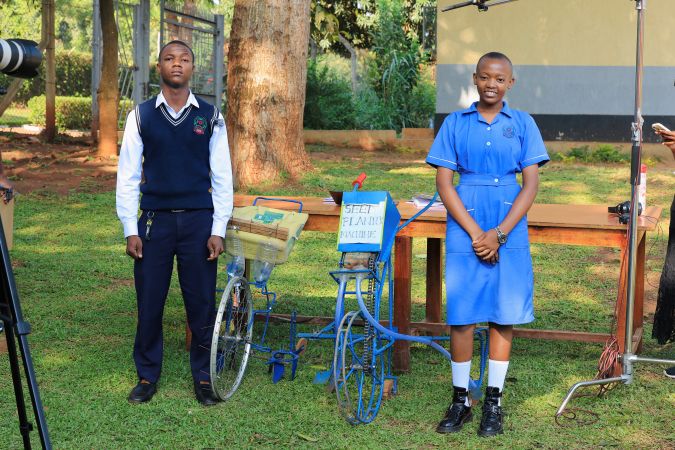 Kakira Secondary School posing for a picture with their prototype
Eight schools have qualified for the August 28 grand finale of the Stanbic National Schools Championship, competing for a multi-million-shilling prize with innovations tackling challenges in agriculture, healthcare, construction, waste management and environmental sustainability.
Eight schools are through to the grand finale of the Stanbic National Schools Championship (NSC), setting the stage for a final contest that will pit some of Uganda’s most promising young innovators against each other on August 28.
The finalists emerged from 913 schools that took part in the 11th edition of the annual championship, which seeks to equip young people with the entrepreneurial, creative and problem-solving skills needed to tackle challenges in their communities.
Beyond the multi-million-shilling cash prize at stake, the competition offers the finalists an opportunity to turn ideas developed in school into practical solutions with potential social and commercial impact.
Diana Ondoga, Manager Corporate Social Investment (CSI) at Stanbic Bank Uganda, said the programme is intended to build a pipeline of entrepreneurs, employees and leaders capable of contributing to Uganda’s future growth.
“We see this programme as our contribution to building Uganda’s next entrepreneurs, employees and leaders,” Ondoga said.

Aga Khan School students showing their product
She said Stanbic engaged 913 participating schools through a nationwide innovation challenge, with students required to work with fellow learners to develop solutions to practical problem scenarios before entering the boot camp selection process.
According to Ondoga, between 90% and 95% of participating schools benefited directly from entrepreneurship and innovation learning, even where their teams did not advance to the boot camp stage.
The programme also supports Uganda’s competency-based curriculum by emphasising Science, Technology, Engineering and Mathematics (STEM), critical thinking, creativity, collaboration and problem-solving.
Following a competitive one-week boot camp hosted by Gayaza High School in May, 12 regional finalist teams advanced to the appraisal stage.
The schools were given seed capital to further develop and refine their ideas, with judges assessing the progress, viability, potential impact and scalability of the innovations before selecting the eight finalists.
The projects span construction, agriculture, environmental conservation, healthcare and digital technology, highlighting the breadth of challenges being tackled by the students.
At Aga Khan High School, students are developing Renewablock Interlocking Blocks, which combine plastic waste and sand to produce durable interlocking bricks.
The innovation seeks to provide a lower-cost alternative construction material while tackling plastic pollution.
“This is to help every Ugandan regardless of their income status because we have people in informal settlements and people in rural areas who wish for better homes that are actually presentable,” said John Arinaitwe, a Senior Five student.
St. Kizito High School, Namugongo, is competing with Tunza Organics, an agribusiness project focused on sustainable food production, value addition and reducing food waste within the school ecosystem.
Barbra Ntunde, a Senior Five student, said the project has challenged students to embrace new approaches to solving everyday problems.
“The projects teach us that we don’t have to always look up to the same things each and every time, but rather accept change, because it’s one of the ways we can change our lives, and also save our environment,” she said.
At Kyebambe Girls Secondary School, the team has developed a Smart Solar Irrigation System designed to help vegetable farmers automate irrigation while reducing water wastage and manual labour.
The solar-powered system regulates watering according to crop requirements and is already functioning, although the students say further development is needed.
“At the moment, we have already developed a smart irrigation kit that is not manually operated. It is a system that works on its own and irrigates automatically,” said Marian Owembabazi.
St. Theresa Girls SS, Nsenyi, is taking a healthcare-oriented approach with its Terra Menstrual Pain Relief Belt, a wearable device designed to help women manage menstrual pain through controlled heat.
Senior Two student Catherine Kabhogwe said the innovation has potential beyond Uganda.
“I know many girls need this solution, and I believe this project can go beyond the borders of Uganda,” she said.
The belt is designed to generate heat of up to 40 degrees Celsius, which the students say is intended to provide relief while remaining safe for the user.

St.Kizito Secondary School students having a taste of one of their products
Iganga Secondary School has developed the Iga Bank Cooler, a post-harvest storage solution aimed at reducing food spoilage and losses among small-scale vegetable farmers and market vendors.
The project responds to a persistent challenge in agricultural value chains, where farmers can lose a substantial share of their produce before it reaches consumers.
“You can’t harvest 50 kilograms of tomatoes then make a loss of 45 kilograms. It means you are not going anywhere,” said Bartha Okurut.
Kakira Secondary School is targeting another labour-intensive part of farming with its Seed Planting Machine, an affordable tool designed to reduce the time and cost involved in planting.
The students say traditional planting methods can take up to eight hours to cover an acre and may require casual labour costing about Shs60,000 per acre.
“Our research showed that planting remains one of the most labour-intensive activities for farmers. We wanted to develop a simple tool that any farmer can afford and use to save both time and money,” said Splendour Tusabe, a Senior Two student.
Bishop Dunstan Nsubuga Memorial SS is showcasing BFC Eco-Drop, or Bottle For Cash, a smart recycling machine that combines waste collection with financial incentives.
Users deposit plastic bottles into the collection unit, which verifies the disposal and credits a small monetary reward to a linked digital account.
The project seeks to demonstrate how technology and incentives can be combined to encourage better plastic waste management.
The eighth finalist, Sedes Sapientiae Academiae, has developed an agro-feed processing machine aimed at helping poultry farmers process their own feed and cut production costs.
Steven Turyamwesiimire said many farmers have access to feed ingredients but lack affordable equipment to process them.
“We decided to make a machine that can help farmers to process their feeds at home without buying processed feed, and this helps them reduce 60% in feeding costs and increase their monthly profits,” he said.
For Stanbic Bank, the championship represents more than a competition for prize money. As the bank marks 35 years of operations in Uganda, the programme is also being positioned as an investment in a generation expected to drive the country’s economic transformation.
Ondoga said the National Schools Championship demonstrates the bank’s belief that Uganda’s economic growth is closely linked to developing the capabilities of its people.
The August 28 finale will therefore determine not only the winning school but also which of the eight student-led innovations can make the strongest case for turning a school project into a viable solution to a real-world problem.
The championship continues to provide a platform where young Ugandans can move beyond identifying community challenges to designing, testing and refining solutions that could ultimately have a life beyond the classroom.
Related Posts
 Why Africa’s Institutions Must Turn Knowledge and Investment into Farmer Prosperity
 Forbes ranks MTN Group third globally on best telecom employer list
 Stanbic experts offer investment insights to navigate current market uncertainty
 Africa Carbon Markets Urged to Turn Potential into Investment and Delivery
 Corporate Buyers Could Help Unlock SAF Market Worth Millions of Tonnes by 2030
 Airbus sees USD420bn Global Aviation Services Boom: Can Africa Capture its Share?
Get business news delivered to you everyday
Latest News

Why Africa’s Institutions Must Turn Knowledge and Investment into Farmer Prosperity

Forbes ranks MTN Group third globally on best telecom employer list

Stanbic experts offer investment insights to navigate current market uncertainty

Africa Carbon Markets Urged to Turn Potential into Investment and Delivery

Bank of Uganda hikes base rate from 9.75% to 12% amidst global tensions

Corporate Buyers Could Help Unlock SAF Market Worth Millions of Tonnes by 2030

Nile Breweries Celebrates 75 Years of Growing with Uganda

Nawangwe Urges Architects to Document Uganda’s Built Heritage

Stanbic installs solar power system at Mbale School for the Deaf

NWSC Seeks Grundfos Partnership to Manufacture Pumps, Spare Parts in Uganda