

Africa’s Aviation Growth Faces Infrastructure Test as Airports Plan for 2035

Africa’s aviation growth is putting pressure on airport infrastructure, with the Aviation Africa Summit set to examine how financing, technology, regulation and better coordination can unlock capacity through 2035.
Africa’s aviation industry is preparing for another phase of growth, but the continent’s ability to translate rising passenger and cargo demand into sustainable expansion will increasingly depend on what happens on the ground.
That infrastructure challenge will take centre stage at the Aviation Africa Summit and Exhibition in Nairobi next month, where airport operators, regulators, technology companies and ground-handling specialists will examine whether Africa’s airports have the capacity, funding models and technology needed to support the industry through 2035 and beyond.
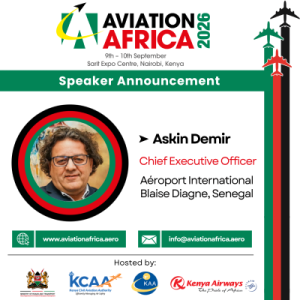 The infrastructure session on September 10 will bring together representatives from ICAO, Kenya Airports Authority, Dakar Airport in Senegal, Swissport Kenya, SITA and the Washington Metropolitan Airports Authority to examine the constraints facing the continent’s airport ecosystem.
At the heart of the discussion is a fundamental question: can Africa build airport capacity quickly enough to match its aviation ambitions without making infrastructure prohibitively expensive for airlines and passengers?
But the challenge extends beyond runways and terminal buildings. African airports face a combination of constrained capital, fragmented regulatory frameworks, lengthy approval processes and difficult decisions over airport charges. While operators need to recover billions of dollars invested in infrastructure, higher charges can increase airline operating costs and ultimately undermine the passenger and traffic growth needed to make the investments commercially viable.
Public-private partnerships are therefore expected to come under scrutiny as governments look for alternatives to relying exclusively on public financing for major airport projects.
The bigger question, however, is whether infrastructure expansion must always mean more concrete. Artificial intelligence, automation and data analytics could allow airports to extract additional capacity from existing infrastructure by identifying operational bottlenecks, improving passenger processing and making aircraft turnarounds more efficient.
For African airports facing capital constraints, that possibility could be particularly important. A terminal operating below its potential because of inefficient processes represents capacity that may be unlocked through technology without immediately requiring a new building. Similarly, better data sharing between airports, airlines, ground handlers and air navigation service providers could help identify congestion before it becomes a constraint on growth.
The airport infrastructure debate also increasingly extends onto the apron and into the airspace. Aircraft turnaround times can determine how efficiently scarce airport capacity is used, while shortages of skilled ground-handling personnel can create delays even where terminal and runway capacity exists.
Better airspace management offers another potential source of capacity. Improved coordination and more efficient flight paths could allow airports and airlines to handle more traffic without corresponding increases in physical infrastructure. This makes the infrastructure challenge a systems issue rather than simply a construction issue.
Africa is already developing major aviation hubs in markets including Ethiopia, Rwanda, Kenya, Morocco and South Africa. Their emergence is raising a broader strategic question over whether the continent can develop globally competitive airports that are also connected into a stronger continental network.
For individual countries, airport investment can be a matter of national prestige and economic development. But the larger opportunity lies in creating an interconnected African aviation system in which hubs complement rather than simply compete with each other.
That could become increasingly important as the African Continental Free Trade Area and expanding intra-African business links increase the need for efficient air connectivity.
The infrastructure session at Aviation Africa will therefore be looking beyond individual airport projects to the operating model needed for the next generation of African aviation.
The question is not simply who will build the next runway or terminal, but who will finance it, how efficiently it will operate, how technology can increase its capacity and whether regulation will allow the investment to generate sustainable returns.
The industry is effectively being asked to look towards 2035 and work backwards. If Africa is to capture the economic benefits of a growing aviation market, the infrastructure supporting that growth must develop at the same pace. For the continent’s airports, the runway to the future may therefore depend as much on finance, data, technology, regulation and coordination as it does on concrete and steel.
Related Posts
 Why Africa’s Institutions Must Turn Knowledge and Investment into Farmer Prosperity
 Forbes ranks MTN Group third globally on best telecom employer list
 Stanbic experts offer investment insights to navigate current market uncertainty
 Africa Carbon Markets Urged to Turn Potential into Investment and Delivery
 Corporate Buyers Could Help Unlock SAF Market Worth Millions of Tonnes by 2030
 Airbus sees USD420bn Global Aviation Services Boom: Can Africa Capture its Share?
Get business news delivered to you everyday
Latest News

Why Africa’s Institutions Must Turn Knowledge and Investment into Farmer Prosperity

Forbes ranks MTN Group third globally on best telecom employer list

Stanbic experts offer investment insights to navigate current market uncertainty

Africa Carbon Markets Urged to Turn Potential into Investment and Delivery

Bank of Uganda hikes base rate from 9.75% to 12% amidst global tensions

Corporate Buyers Could Help Unlock SAF Market Worth Millions of Tonnes by 2030

Nile Breweries Celebrates 75 Years of Growing with Uganda

Nawangwe Urges Architects to Document Uganda’s Built Heritage

Stanbic installs solar power system at Mbale School for the Deaf

NWSC Seeks Grundfos Partnership to Manufacture Pumps, Spare Parts in Uganda