

Standard Bank economist cites debt costs as major risk factor for Uganda
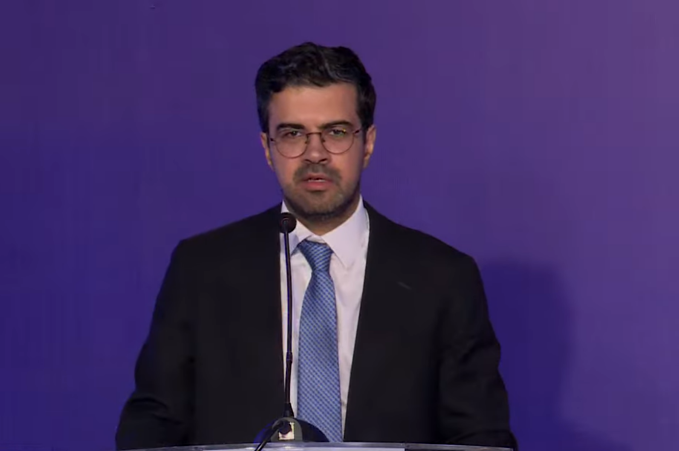 Qureishi said the surge in government borrowing puts upward pressure on domestic interest rates, effectively crowding out the private sector from accessing affordable credit.
Standard Bank Group economist and Head of Africa Region Economic Research, Jibran Qureishi has said the government’s recourse to using supplementary budgets to plug deficits erodes the credibility of its fiscal planning and hurts business expansion.
In his keynote presentation during the recently held 5th Stanbic Economic Forum in Kampala, Qureshi said, “These additional spending requirements often lead to increased domestic borrowing. This surge in government borrowing puts upward pressure on domestic interest rates, effectively crowding out the private sector from accessing affordable credit.”
Last December the government submitted a UGX8 trillion supplementary budget six months after the Minister of Finance read the national budget projecting UGX72 trillion in spending during financial year 2025/26.
The theme of the Forum discussions was ‘Uganda’s Inflection Point: Competing in a Rewired Global Economy’. Participants were drawn from both the public and private sector, including policymakers and business leaders. Stanbic Bank is the anchor subsidiary of Stanbic Uganda Holdings Limited which in turn is part of the Standard Bank Group.
Qureishi, who has been periodically visiting Uganda for the past 15 years, specializes in analyzing macroeconomic trends, African debt sustainability, and monetary policy across the continent, frequently providing insights on inflationary pressures and foreign exchange market risks.
He praised Uganda’s resilient and rapid economic trajectory with current GDP growth at 6.5%, but queried why Uganda’s good macroeconomic outlook did not translate into an equally ‘good dinner table story’ at the microeconomic level.
Qureishi said despite impressive GDP figures, the benefits have yet to fully reach ordinary citizens. He emphasized that inclusive growth—translating stability into jobs and higher incomes—remains the true test for policymakers.
He said heavy government borrowing from the domestic market continues to limit the private sector by keeping interest rates relatively high, making it difficult for especially Small and Medium Enterprises (SMEs) to access affordable credit for expansion.
However, he commended the government for avoiding the ‘premature monetisation’ of oil revenues, which has preserved investor confidence. This usually involves governments borrowing against future revenues that may not materialize or may be lower than expected, creating debt management challenges if production is delayed.
As of 2026, Micro, Small, and Medium Enterprises (MSMEs) account for 90% Uganda’s private sector. These enterprises are often described as the backbone of the economy, comprising over 1.1 million businesses. Limited access to finance remains a leading concern, with interest rates ranging from 18% to 24% together with often stringent collateral requirements.
Qureishi said for growth to be inclusive, capital must flow into the private sector, particularly to support the informal economy and youth-led innovative sectors.
He said for Uganda to maintain its macroeconomic momentum as it approaches first oil production later this year, the government should shift away from reliance on supplementary budgets to ensure more predictable and sustainable growth.
He conceded that the government is under significant pressure to boost revenues to reduce deficits, but cautioned that targeting ‘golden goose’ sectors—highly productive or innovative areas—solely for quick revenue, stifles the very innovation driving future growth.
With the onset of oil production, Uganda is heading towards the exclusive ‘seven percent’ club, composed of countries achieving a GDP growth rate of seven percent.
In the meantime, Qureshi said, there are three critical areas that need close attention. He cited debt sustainability, highlighting the growing risk posed by high debt-servicing costs.
He said, “A significant portion of domestic revenue is being consumed by interest payments, which limits the government’s fiscal space to fund essential social sectors like education and health.”
He also expressed concerns about the lag between heavy infrastructure spending (such as the Standard Gauge Railway and oil-related projects) and actual economic productivity. He warned that if these projects do not yield timely returns, the tax burden on citizens could increase through higher Value Added Tax (VAT) or other consumption taxes.
He also touched on currency volatility and inflationary risks mostly arising from external forces, such as a change of stance by the US Fed (United States central bank).
He said, “The Ugandan Shilling faces potential depreciation risks due to a strengthening US Dollar and global interest rate environments. This volatility could lead to ‘imported inflation’, raising the cost of essential imports and dampening consumer demand.”
Related Posts
 Stanbic Seeks Northern Uganda Business Feedback as It Marks 35 Years in Country
 Uganda Emerges as Africa’s Largest Organic Farming Country as Exports Reach USD225 Million
 SITA Acquisition of Collins Airport Solutions Signals Moves to Consolidate Aviation Technology
 Uganda Coffee Roasters Tap Richard Rugaya as Executive Director, with Focus on Commercial Growth
 Equity Bank Reports UGX37.6 Billion in Green Loans as Uganda Seeks to Scale Climate Investment
 Why Africa’s Institutions Must Turn Knowledge and Investment into Farmer Prosperity
Get business news delivered to you everyday
Latest News

Stanbic Seeks Northern Uganda Business Feedback as It Marks 35 Years in Country

Uganda Emerges as Africa’s Largest Organic Farming Country as Exports Reach USD225 Million

SITA Acquisition of Collins Airport Solutions Signals Moves to Consolidate Aviation Technology

Uganda Coffee Roasters Tap Richard Rugaya as Executive Director, with Focus on Commercial Growth

Equity Bank Reports UGX37.6 Billion in Green Loans as Uganda Seeks to Scale Climate Investment

Forbes ranks MTN Group third globally on best telecom employer list

Stanbic experts offer investment insights to navigate current market uncertainty

Africa Carbon Markets Urged to Turn Potential into Investment and Delivery

Bank of Uganda hikes base rate from 9.75% to 12% amidst global tensions

Corporate Buyers Could Help Unlock SAF Market Worth Millions of Tonnes by 2030