

Oman’s SalamAir opens -Muscat-Kigali route, linking East Africa to an emerging Gulf aviation hub
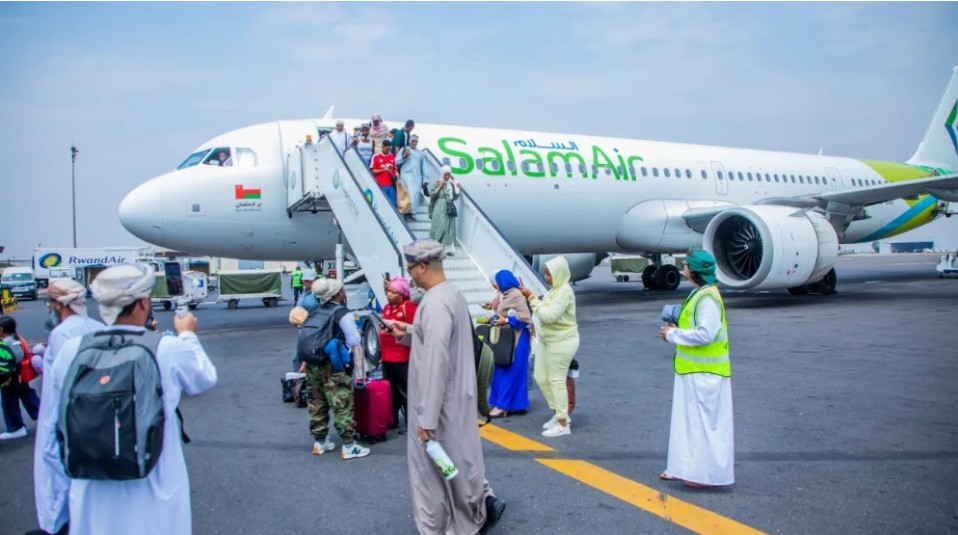 Passengers disembark SalamAir flight OV371 at Kigali International Airport on July 21, marking the inauguration of the airline’s new direct service between Muscat, the capital of Oman, and Kigali. The twice-weekly route strengthens air connectivity between the Gulf and East Africa.
SalamAir has launched direct twice-weekly flights between Muscat and Kigali, adding a new Gulf gateway for East African travellers. Beyond improving connectivity, the route reflects Oman’s aviation ambitions under Vision 2040 and Kigali’s growing status as a regional aviation hub.
SalamAir on Tuesday inaugurated direct flights between Muscat and Kigali, opening a new Gulf gateway for East African travellers and reinforcing Rwanda’s growing appeal as an aviation, tourism and investment hub.
The inaugural flight, OV371, landed at Kigali International Airport at 11:44 a.m. local time aboard an Airbus A321neo after departing Muscat with an official Omani delegation to commemorate the launch. The new service, which will operate twice weekly, marks SalamAir’s newest African destination and extends the airline’s network deeper into East Africa.
While the route adds another travel option, its significance extends well beyond the launch of a new city pair. It reflects a broader shift in Gulf aviation strategy, with airlines increasingly looking beyond the established mega hubs of Dubai, Doha and Abu Dhabi to capture emerging traffic flows into Africa’s fast-growing economies.
The Omani low-cost carrier becomes the latest Middle Eastern airline to establish direct links with Rwanda as demand for business, tourism and transit travel continues to grow.
For decades, East African travellers heading to Asia, the Middle East and Europe have relied heavily on connections through the Gulf’s major hubs. SalamAir’s entry introduces Muscat as an alternative gateway, broadening travel choices while strengthening Oman’s ambition to position Muscat International Airport as a competitive regional hub under the country’s Vision 2040 economic diversification strategy.
For Rwanda, the route reinforces a deliberate policy of attracting multiple international airlines alongside the expansion of national carrier RwandAir. Rather than relying on a single airline to drive connectivity, Kigali has steadily built an aviation ecosystem that combines a growing home carrier with increasing access from foreign airlines, enhancing competition and expanding international reach.
SalamAir Chief Executive Officer Adrian Hamilton-Manns described Kigali as a high-potential market that fits the airline’s long-term expansion plans.
“The launch of Kigali marks another important milestone in SalamAir’s growth journey as we continue expanding our network into high-potential markets that support tourism, business and stronger international connectivity,” he said.
Hamilton-Manns added that Rwanda presents significant opportunities while the new service advances both SalamAir’s commercial growth strategy and Oman’s Vision 2040 objectives.
The airline said the twice-weekly flights are expected to stimulate tourism, business travel and cultural exchange while providing passengers with seamless onward connections across SalamAir’s expanding network spanning the Middle East, Asia, Africa and Europe.
Rwanda’s Ambassador to the Sultanate of Oman, Dan Munyuza, said the direct link would strengthen the movement of travellers, businesses and cargo while creating new opportunities for trade, tourism and investment between the two countries.
Beyond strengthening bilateral relations, the launch also reflects a wider transformation taking place across African aviation. As Gulf carriers seek growth beyond their traditional markets, secondary African cities are becoming increasingly attractive destinations. Rising incomes, expanding tourism, improving business environments and underserved international air links are encouraging airlines to establish direct services instead of routing passengers through larger African gateways.
For Kigali, the strategy further cements its ambition to become a regional aviation hub despite Rwanda’s relatively small domestic market. A steady stream of new international routes over the past decade has positioned the city as one of East Africa’s fastest-growing aviation gateways and an increasingly important entry point into the Great Lakes region.
Kigali expands SalamAir’s African footprint while providing access to a market where international low-cost competition remains relatively limited. The service also offers East African travellers an alternative Gulf connection as airlines compete more aggressively on fares, convenience and network reach.
Although initially operating only twice a week, the Muscat-Kigali route signals the deepening of aviation ties between Africa and the Gulf and illustrates how mid-sized carriers are increasingly viewing East Africa as a promising frontier for future aviation growth.
Related Posts
 Independence Marathon Turns to Blood Storage Gap in Maternal Health Drive
 Fine Spinners Injects Fresh USD5m Into Technology as Uganda Textile Maker Targets African, European Markets
 Equity Trade Mission Puts Uganda’s Manufacturing Capacity to Regional Test
 Uganda Green Entrepreneurs Set for Paris Visit as Stanbic-France Partnership Graduates 106
 Entebbe Airport Passenger Traffic Recovers in August but Remains Below 2025 Levels
 Equity Bank Explores Value-Chain Financing to Support Zigoti Coffee Expansion
Get business news delivered to you everyday
Latest News

Independence Marathon Turns to Blood Storage Gap in Maternal Health Drive

Fine Spinners Injects Fresh USD5m Into Technology as Uganda Textile Maker Targets African, European Markets

Equity Trade Mission Puts Uganda’s Manufacturing Capacity to Regional Test

Uganda Seeks to Calm Coffee, Cocoa Markets as Global Prices Fluctuate on Positive Sentiment

Uganda Green Entrepreneurs Set for Paris Visit as Stanbic-France Partnership Graduates 106

Entebbe Airport Passenger Traffic Recovers in August but Remains Below 2025 Levels

Nile Breweries, Next Media Renew Road Safety Push with Focus on Boda Boda Riders

Uganda Breaks Ground on USD310m Kampala Fuel Terminal, Targets September 2028 Completion

Uganda Will Not Close Its 2.4-Million-Unit Housing Deficit with Ribbon-Cuttings in Kira

Nairobi’s 2029 World Athletics Win Draws Doping Scrutiny in UK Media