

Bank of Uganda maintains base rate at 9.75 pc for over 12 months
 Atingi-Ego said inflation has remained subdued, supported by prudent monetary policy, a stronger exchange rate, and favourable prices.
The Bank of Uganda Monetary Policy Committee (MPC) has decided to maintain the Central Bank Rate (CBR) at 9.75 pc despite the domestic macroeconomic environment continuing to strengthen with inflation staying within manageable levels.
Chaired by BOU Governor, Micheal Atingi-Ego, the MPC took a cautionary stance in light of both global and domestic uncertainties that could affect the near-term outlook. The CBR is the benchmark from which commercial banks base their lending rates and BoU has maintained it 9.75% since October 2024.
In a statement Atingi-Ego said, “Inflation has remained subdued, supported by prudent monetary policy, a stronger exchange rate, and favourable prices. Over the past 12 months, annual headline inflation averaged 3.6 pc, while core inflation averaged 3.9 pc, both remaining below the medium-term target of 5 pc.”
According to the statement, GDP growth reached 6.3 pc in financial year 2024/25, up from 6.1 pc in the previous year, supported by improvements in agricultural and industrial activities. On the expenditure side, growth was driven by increased consumption and investment. High-frequency indicators point to continued confidence in the economic environment in FY2025/2026. Next year, Uganda is due to begin commercial sales of oil
“The economy is projected to expand 6.5 pc to 7 pc in FY2025/26, rising to an average of around 8 pc in the medium term. This reflects Uganda’s sustained economic resilience, underpinned by a slight improvement in global growth, prudent monetary policy and targeted fiscal measures that have preserved macroeconomic stability and reinforced investor confidence. Growth is further supported by the ongoing implementation of the Tenfold Growth Strategy which is unlocking opportunities in agriculture, infrastructure, and the extractive industries. Indeed, a major global credit rating agency recently revised its outlook for Uganda to positive from stable because the economy continues to exhibit stronger momentum compared to her peers.”
The upside risks include heightened geopolitical tensions that could disrupt global energy and food supply chains, adverse weather conditions that constrain agricultural output, and exchange rate pressures from weaker capital floss or delayed oil revenues. Additionally, stronger domestic demand, particularly from public investment, could intensify core inflation pressures.
Downside risks include continued capital inflows related to oil sector developments, favourable weather conditions enhancing food supply, and easing monetary conditions that could lower imported inflation. Overall the inflation outlook remains balanced, with core inflation expected to remain close to the medium-term target.
Related Posts
 CSOs warn rising debt, arrears and weak public investment threaten Uganda’s fiscal stability
 Uganda’s export surge signals shift toward industrial depth and trade resilience
 Stanbic Bank joins Buganda Kingdom to strengthen coffee chain
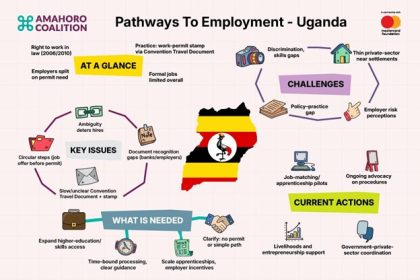 Study charts pathways for expanding employment opportunities for refugees in Uganda
 The Thin Green Line: Uganda’s Soil Crisis a National Food Security Threat
 Talks held in Kigali to brainstorm regional trade bottlenecks
Get business news delivered to you everyday
Latest News

Africa’s aviation safety improves in 2025 but region still tops global accident rates

CSOs warn rising debt, arrears and weak public investment threaten Uganda’s fiscal stability

Masindi farmers raise the alarm as counterfeit agro-inputs threaten yields

Uganda Airlines secures Ethiopian Boeing 787 to restore long-haul services

Boeing, FASESA expand Africa space STEM program to South Africa

Kenya Airways leads East Africa in resuming Dubai flights as flydubai returns to Entebbe

Uganda’s export surge signals shift toward industrial depth and trade resilience

Qatar Airways schedules Entebbe flights as Gulf carriers cautiously restart operations

African airlines outpace global industry in January rebound as IATA warns on geopolitical risks

This illegal US-Israeli attack on Iran is also an assault on the United Nations