

Uganda Tightens Monetary Grip as Kenya Widens Access to Investment Funds
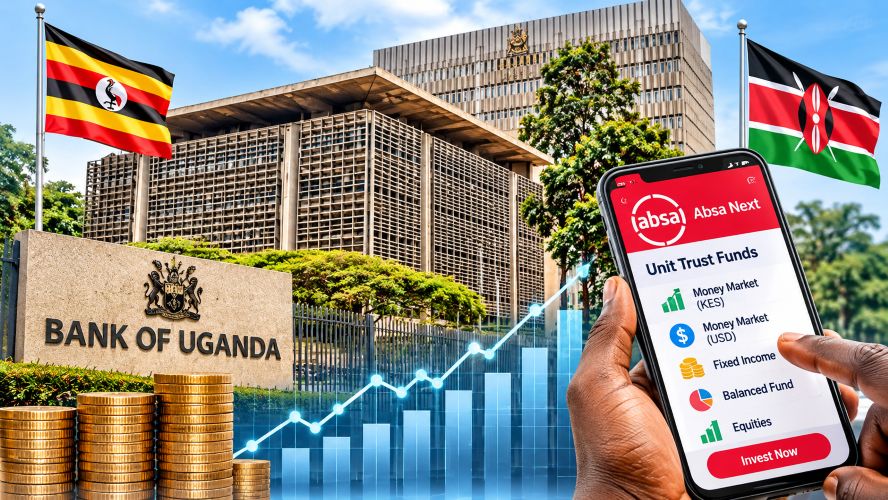 Uganda’s monetary policy adjustments and Kenya’s expanding digital investment platforms reflect the contrasting forces shaping East Africa’s capital markets.
Uganda is maintaining tight monetary conditions amid currency and inflation pressures, while Kenya’s Absa Bank expands digital access to investment funds. The contrasting developments highlight the opportunities and constraints shaping Africa’s capital markets.
Africa’s capital markets are operating in an increasingly delicate environment, with monetary authorities balancing currency stability and inflation risks while financial institutions explore ways of widening access to investment opportunities.
Developments in Uganda and Kenya illustrate two sides of this changing landscape. While Kampala is maintaining tight monetary conditions amid exchange-rate and inflation pressures, Nairobi is seeing efforts to make collective investment products more accessible to ordinary savers through digital platforms.
The developments point to a broader challenge facing African financial markets: mobilising domestic savings into productive investment while managing the cost and availability of capital.
According to London-based news and market intelligence platform Allen Dreyfus, the Bank of Uganda’s decision to maintain its Central Bank Rate (CBR) at 12pc signals continuity in its monetary policy stance, but adjustments to the operating framework suggest that the central bank remains alert to emerging liquidity pressures.
The widening of the policy corridor to plus or minus three percentage points, alongside increases in the rediscount and bank rates to 16pc and 17pc respectively, respectively, gives the monetary authorities greater room to manage short-term liquidity conditions without immediately changing the benchmark interest rate.
The distinction matters for financial markets because a stable policy rate does not necessarily translate into easier monetary conditions for banks, businesses or investors. The cost and availability of liquidity remain influenced by the central bank’s operational framework, exchange-rate movements and inflation expectations.
For bond investors, foreign-exchange traders and businesses dependent on bank financing, the message is that Uganda is not signalling a broad easing of financial conditions. Rather, the central bank appears intent on retaining control over monetary transmission as the shilling faces pressure and inflation risks complicate the outlook.
This has implications for government securities and private-sector borrowing. Elevated interest rates can sustain demand for relatively attractive fixed-income returns, but they also increase the cost of financing investment and place pressure on businesses seeking affordable credit.
Kenya’s developments offer a different perspective on the challenge of deepening capital markets.
Absa Bank Kenya’s introduction of five Unit Trust funds through its Absa Next mobile application represents an effort to bring investment products closer to retail customers, using digital distribution to reduce some of the traditional barriers to participation.
The funds cover Kenyan shilling and US dollar money markets, fixed income, balanced portfolios and equities, giving investors access to different asset classes and risk profiles through a single digital platform.
The bank says its equity fund has delivered year-to-date returns of up to 15.95%, although such performance should be viewed against market conditions and does not guarantee future returns.
More significant than the reported performance is the distribution model. By placing collective investment products on a mobile application, Absa is seeking to make participation in capital markets less dependent on traditional investment channels and the relatively high entry barriers associated with direct securities investment.
Unit trusts pool money from multiple investors and deploy it across a portfolio of assets managed by professionals. They can therefore provide smaller investors with exposure to financial instruments that might otherwise require greater capital, expertise and time to access individually.
The opportunity, however, extends beyond digital convenience. Africa’s capital markets need stronger domestic investor participation if they are to provide a deeper and more reliable source of long-term financing for businesses and governments.
The challenge is that access alone does not guarantee meaningful participation. Household incomes, financial literacy, confidence in investment institutions, market liquidity and the availability of suitable financial products will continue to influence how much savings can be channelled into formal investment.
Taken together, the Ugandan and Kenyan developments illustrate the different pressures shaping the continent’s financial markets. Monetary authorities are concerned with preserving stability and managing liquidity, while financial institutions are looking for ways to expand the pool of investors and mobilise domestic savings.
The two objectives are interconnected. Deep capital markets require monetary and currency stability, but they also need accessible investment instruments capable of attracting savings beyond institutional investors and wealthy individuals.
Related Posts
 AU pushes Climate-smart Irrigation to Deliver Kampala Agenda Ambitions
 Mastercard Targets Africa’s Costly Cross-border Payment Bottlenecks with Single-use Virtual Travel Card
 Ugandan Designers Earn Continental Recognition at Addis Fashion and Leather Fair
 Nile Breweries Invests UGX4bn in Sebei Barley Handling Facility as Local Sourcing Expands
 Isaiah Rwanyekiro: Wearing my Scars with Pride After Years of Battling Cancer
 Equity Bank Unveils Richard Byarugaba as it Targets Ugandans in Kenya with Cross-border Investment Proposition
Get business news delivered to you everyday
Latest News

Uganda Tightens Monetary Grip as Kenya Widens Access to Investment Funds

AU pushes Climate-smart Irrigation to Deliver Kampala Agenda Ambitions

Mastercard Targets Africa’s Costly Cross-border Payment Bottlenecks with Single-use Virtual Travel Card

Ugandan Designers Earn Continental Recognition at Addis Fashion and Leather Fair

Nile Breweries Invests UGX4bn in Sebei Barley Handling Facility as Local Sourcing Expands

Equity Bank Extends Women’s Enterprise Financing Programme to Buvuma Island

Isaiah Rwanyekiro: Wearing my Scars with Pride After Years of Battling Cancer

SITA’s New eWAS+ Electronic Flight Bag Integrates Weather and Flight Operations Data for Pilots

United Opens new Dulles Concourse as it Expands International Network

ICEA LION Urges Stronger Employee Protection as Insurer Backs HR Conference with UGX15m