

Stanbic injects UGX50m into Bunyoro University to power innovation hub

Stanbic Bank Uganda commits UGX50 million to establish an ICT innovation hub at Bunyoro University, marking the first private sector investment in the institution ahead of its 2027 launch.
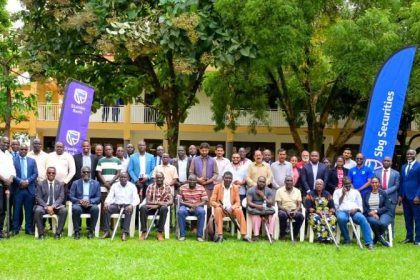
Stanbic Bank Uganda has committed UGX50 million to support the operationalisation of Bunyoro University, becoming the first private sector player to back the newly established institution in the Albertine region.
The funding will go toward the establishment of an ICT Maker Space—an innovation hub designed to promote hands-on learning, entrepreneurship and digital skills development among students and the wider community.
Speaking at the handover ceremony in Hoima City on March 26, the bank’s Chief Executive, Mumba Kalifungwa, said the investment reflects the lender’s long-standing focus on education as a driver of economic transformation.
“Education is a core pillar in everything we do, accounting for about 70 percent of our annual CSI budget,” Kalifungwa said. “We believe it is a critical engine for Uganda’s continued development and long-term economic sustainability.”
The Maker Space is expected to serve as a centre for creativity and practical problem-solving, providing students with access to tools and platforms to develop solutions aligned with local economic needs. It will also support collaboration between the university and surrounding communities.
Kalifungwa said the initiative aligns with Stanbic’s broader development agenda, which prioritises financial inclusion, job creation, infrastructure development, climate resilience and corporate philanthropy.
“Bunyoro University represents a bold and transformative vision,” he said. “Its model, where 50 percent of learning will be practical and community-based, ensures graduates are equipped not just with knowledge, but with the ability to solve real-world challenges.”
The university, which is expected to admit its first cohort in October 2027, will launch with 18 academic programmes already accredited by the National Council for Higher Education. The curriculum is structured to deliver industry-relevant skills, particularly in a region undergoing rapid transformation driven by oil and gas development.
Stanbic’s intervention comes as government and local leaders seek to position the institution as a catalyst for skills development and industrial growth in the resource-rich Albertine region.
Professor Samuel Kyamanywa, who chairs the university’s task force, said the Maker Space will play a critical role in shaping the institution’s academic and innovation agenda.
“The Maker Space will be a hub for nurturing innovation and creativity, helping us deliver on our mission of building adequate and relevant human capital for this region,” Kyamanywa said.
Local authorities have also underscored the importance of private sector support in bridging resource gaps as the university takes shape.
Godwin Angalia said partnerships such as Stanbic’s are essential to ensuring the institution is adequately equipped before it becomes fully operational.
“The government may not be in a position to provide everything needed for the university,” Angalia said. “Stanbic Bank has not waited for students to enter lecture rooms; they are ensuring that when students arrive, they find everything in place.”
Beyond the university, Stanbic has earmarked up to Shs1 trillion by 2028 to support small and medium enterprises, expand financial inclusion through digitisation, and invest in education, health and climate-related initiatives.
The bank’s latest investment builds on its broader track record in youth and skills development, including the Stanbic National Schools Championship, which has reached more than 600,000 students and supported over 500 schools nationwide, while helping to incubate student-led enterprises.
Analysts say such interventions highlight the growing role of private capital in complementing public investment, particularly in education and skills development, as Uganda positions itself to harness opportunities in emerging sectors.
With Bunyoro University expected to anchor human capital development in the Albertine region, early-stage investments in innovation infrastructure could prove critical in shaping a workforce capable of supporting the country’s next phase of industrial growth.
Related Posts
 Stanbic Seeks Northern Uganda Business Feedback as It Marks 35 Years in Country
 SITA Acquisition of Collins Airport Solutions Signals Moves to Consolidate Aviation Technology
 Uganda Coffee Roasters Tap Richard Rugaya as Executive Director, with Focus on Commercial Growth
 Equity Bank Reports UGX37.6 Billion in Green Loans as Uganda Seeks to Scale Climate Investment
 Nile Breweries Celebrates 75 Years of Growing with Uganda
 Stanbic installs solar power system at Mbale School for the Deaf
Get business news delivered to you everyday
Latest News

Stanbic Seeks Northern Uganda Business Feedback as It Marks 35 Years in Country

Uganda Emerges as Africa’s Largest Organic Farming Country as Exports Reach USD225 Million

SITA Acquisition of Collins Airport Solutions Signals Moves to Consolidate Aviation Technology

Uganda Coffee Roasters Tap Richard Rugaya as Executive Director, with Focus on Commercial Growth

Equity Bank Reports UGX37.6 Billion in Green Loans as Uganda Seeks to Scale Climate Investment

Why Africa’s Institutions Must Turn Knowledge and Investment into Farmer Prosperity

Forbes ranks MTN Group third globally on best telecom employer list

Stanbic experts offer investment insights to navigate current market uncertainty

Africa Carbon Markets Urged to Turn Potential into Investment and Delivery

Bank of Uganda hikes base rate from 9.75% to 12% amidst global tensions