

New Mombasa–Goma fibre link goes live, opening digital highway across East Africa
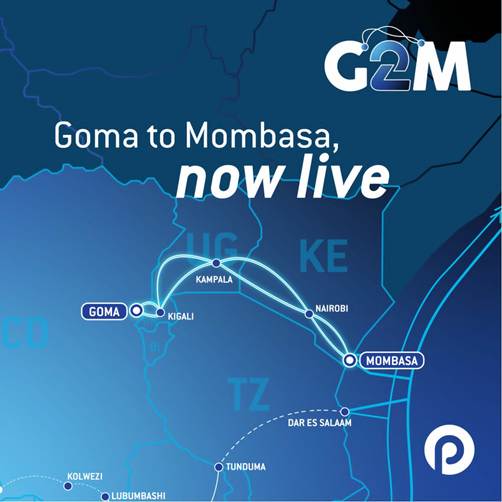
A new 2,000-kilometre fibre route linking Mombasa to Goma has gone live, creating a protected digital highway across Kenya, Uganda, Rwanda and eastern DRC. The corridor strengthens cross-border connectivity, reduces reliance on fragmented routes and brings inland East African markets closer to global networks.
Pan-African network services provider Paratus Group has switched on a 2,000-kilometre terrestrial fibre route connecting Mombasa to Goma via Nairobi, Kampala and Kigali, creating what the company describes as a protected digital highway for carriers, internet service providers and large enterprises operating across the region.
The Goma-to-Mombasa (G2M) route is now live and carrying traffic for its first wholesale customers, delivering direct access from inland markets to global subsea cable capacity on the Kenyan coast. Officials say, for eastern DRC, Rwanda and Uganda in particular, the link reduces reliance on fragmented routes and improves latency, reliability and redundancy for international connectivity.
The launch reflects a broader shift in how Africa’s digital backbone is being built. Rather than isolated national networks, operators are increasingly investing in continuous, multi-country corridors designed to support regional trade, cloud services and cross-border data flows. By directly linking eastern DRC to coastal cable landings, the new route brings one of the continent’s most underserved markets closer to global networks.
Paratus said the route runs through fully licensed operating companies in Kenya, Uganda and Rwanda, with local partnerships underpinning the build. In Uganda, the project was delivered in collaboration with Roke Telkom, while MoveOn Telecoms partnered on the Kenyan segment. The network interconnects with key data centres in each major city along the route, allowing carriers and enterprises to localise traffic while maintaining international reach.
For businesses in eastern Congo and neighbouring countries, the implications extend beyond faster internet speeds. Reliable fibre connectivity is increasingly seen as foundational infrastructure, enabling sectors such as fintech, mining, logistics, energy, manufacturing and digital services to operate at scale and integrate into regional and global value chains.
Paratus Group Chief Commercial Officer Martin Cox described the link as more than a technical upgrade, framing it as infrastructure with economic consequences for the region. He said the protected route from the coast into Goma dramatically improves resilience while opening new commercial opportunities across Kenya, Uganda, Rwanda and the DRC.
The G2M route also strengthens Paratus’ broader continental network strategy. It complements the company’s East–West fibre backbone, which stretches from Maputo to Swakopmund in southern Africa and interconnects with the Equiano subsea cable, providing redundancy and low-latency links between Africa and Europe. Together, the networks position Paratus among a small group of operators offering seamless regional and cross-continental connectivity through a single provider.
East Africa, home to more than 200 million people, is one of the continent’s fastest-growing economic regions, with rapid expansion in ICT-driven sectors. As cloud adoption accelerates and governments push digital trade and services, demand for secure, enterprise-grade connectivity is rising sharply.
With the Mombasa–Goma corridor, Paratus is betting that Africa’s next phase of growth will depend as much on digital highways as on physical ones. Much like historic trade routes that linked the interior to the coast, the new fibre link is designed to pull inland economies deeper into regional and global commerce—this time through data rather than traditional commodities.
Related Posts
 EgyptAir inducts first A350-900 into long-haul fleet
 From Kampala to Dubai, Desert & Nile Artistry brings African heritage to the global stage
 New monitoring methods could reshape how Africa safeguards bridges and pressure vessels
 Billionaires.Africa ranks Charles Mbire richest investor on the Uganda Securities Exchange in 2026
 Uganda’s health financing model under strain as donor retreat exposes structural fragility
 Why Experience Still Matters in Aviation — and why Girma Wake’s Uganda appointment is being misread
Get business news delivered to you everyday
Latest News

EgyptAir inducts first A350-900 into long-haul fleet

From Kampala to Dubai, Desert & Nile Artistry brings African heritage to the global stage

New Mombasa–Goma fibre link goes live, opening digital highway across East Africa

New monitoring methods could reshape how Africa safeguards bridges and pressure vessels

Billionaires.Africa ranks Charles Mbire richest investor on the Uganda Securities Exchange in 2026

Uganda’s health financing model under strain as donor retreat exposes structural fragility

Uganda study shows how treating depression can strengthen HIV care

Stanbic Economic Forum returns with focus on Uganda’s competitiveness in a shifting global economy

Equity Bank, UKAID launch affordable electric cooking finance to accelerate clean energy transition in Uganda

Airbus sees Asia-Pacific aviation services market surging to USD 138.7bn by 2044