

Africa’s Green Economy Summit 2026 opens in Cape Town with focus on bankable action
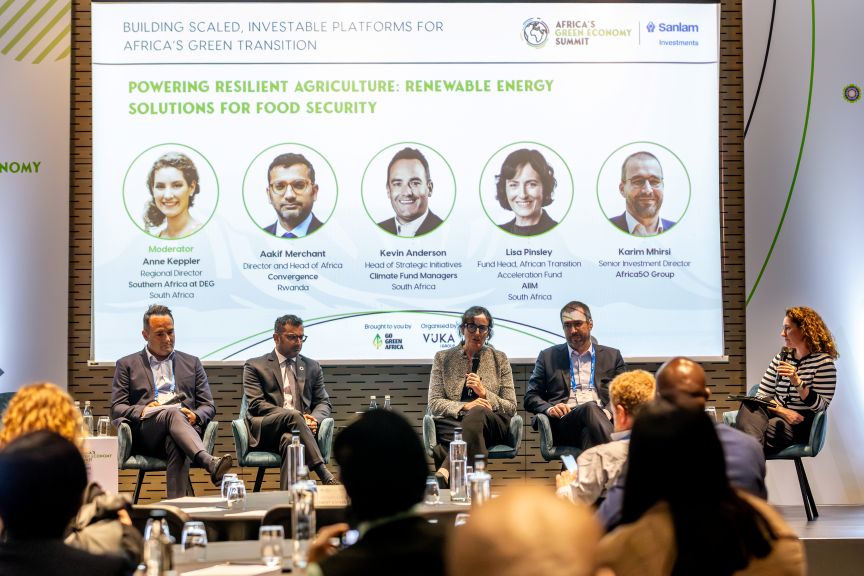
Africa’s Green Economy Summit 2026 has opened in Cape Town, positioning the continent’s green and blue economies as immediate, bankable investment frontiers rather than distant climate ambitions.
The Africa’s Green Economy Summit (AGES) 2026 has opened in Cape Town, bringing together policymakers, financiers and innovators in a push to convert climate ambition into investable projects.
Held under the theme “From Ambition to Action: Scaling Opportunities in Africa’s Green and Blue Solutions,” the summit signals a deliberate shift from high-level pledges to concrete deal-making. Organisers say the objective is clear: position Africa’s environmental transition as a driver of economic growth rather than a compliance obligation.
Proudly sponsored by Sanlam Investments, the gathering is structured not simply as a discussion forum but as a marketplace connecting project developers with capital.
“Ambition lights the path, but it does not pave it. To transform our economies and uplift our communities, we must move beyond rhetoric to robust execution,” said Lerato Mbele, the summit moderator. She described the platform as a space where visionaries and investors align to ensure Africa’s green transition is scalable and profitable.
A major focus of this year’s agenda is the blue economy — spanning fisheries, coastal tourism, maritime logistics and ocean-based industries — which already contributes nearly $300 billion annually to Africa’s GDP and supports an estimated 46 million livelihoods.
Organisers argue that this vast economic base remains under-leveraged, even as climate pressures and population growth intensify demands on marine and coastal ecosystems.
At the same time, the green economy — anchored by renewable energy and climate-smart agriculture — is projected globally to unlock up to $10 trillion in business value over the next decade. Africa, with its youthful population and natural resource base, is positioning itself to capture a significant share of that opportunity, with projections pointing to the potential creation of hundreds of millions of jobs.
Addressing delegates, Naren Singh, South Africa’s Deputy Minister of Forestry, Fisheries and Environment, framed sustainability as an economic imperative rather than an environmental afterthought.
“Our journey toward a low-carbon future must be defined by a fundamental truth: sustainability is a three-legged stool, balancing the health of our planet, the prosperity of our people and the creation of shared value,” Singh said. “By investing in our natural capital, we are investing in the most resilient infrastructure of all – our communities.”
Over two days, the summit floor has hosted interactive policy sessions, live pitches from emerging green entrepreneurs and curated networking forums aimed at accelerating partnerships and unlocking financing for bankable projects.
AGES is hosted by VUKA Group, which positions the summit as a catalyst for practical outcomes across sectors including energy, mobility, infrastructure, agriculture, water, waste and the blue economy.
Organisers describe the event as a declaration of intent: that Africa’s economic resilience and environmental stewardship are increasingly inseparable.
As climate risks mount and global capital seeks credible sustainable investment destinations, AGES 2026 is pitching the continent not as a passive recipient of climate finance, but as an active architect of a green growth model rooted in its own natural capital and demographic dynamism.
Related Posts
 Independence Marathon Turns to Blood Storage Gap in Maternal Health Drive
 Fine Spinners Injects Fresh USD5m Into Technology as Uganda Textile Maker Targets African, European Markets
 Equity Trade Mission Puts Uganda’s Manufacturing Capacity to Regional Test
 Uganda Seeks to Calm Coffee, Cocoa Markets as Global Prices Fluctuate on Positive Sentiment
 Uganda Green Entrepreneurs Set for Paris Visit as Stanbic-France Partnership Graduates 106
 Entebbe Airport Passenger Traffic Recovers in August but Remains Below 2025 Levels
Get business news delivered to you everyday
Latest News

Independence Marathon Turns to Blood Storage Gap in Maternal Health Drive

Fine Spinners Injects Fresh USD5m Into Technology as Uganda Textile Maker Targets African, European Markets

Equity Trade Mission Puts Uganda’s Manufacturing Capacity to Regional Test

Uganda Seeks to Calm Coffee, Cocoa Markets as Global Prices Fluctuate on Positive Sentiment

Uganda Green Entrepreneurs Set for Paris Visit as Stanbic-France Partnership Graduates 106

Nile Breweries, Next Media Renew Road Safety Push with Focus on Boda Boda Riders

Equity Bank Explores Value-Chain Financing to Support Zigoti Coffee Expansion

Uganda Breaks Ground on USD310m Kampala Fuel Terminal, Targets September 2028 Completion

Uganda Will Not Close Its 2.4-Million-Unit Housing Deficit with Ribbon-Cuttings in Kira

Nairobi’s 2029 World Athletics Win Draws Doping Scrutiny in UK Media