

When the future arrived early: Revisiting Demolition Man in 2025
What Demolition Man Got Right
-
Predictive policing and AI-driven surveillance
-
Non-physical intimacy through virtual interfaces
-
Sanitised language and automated censorship
-
Technology replacing punishment with control
-
Safety achieved — but at the cost of spontaneity
It’s 2025 — just seven years shy of the world Demolition Man imagined back in 1993.
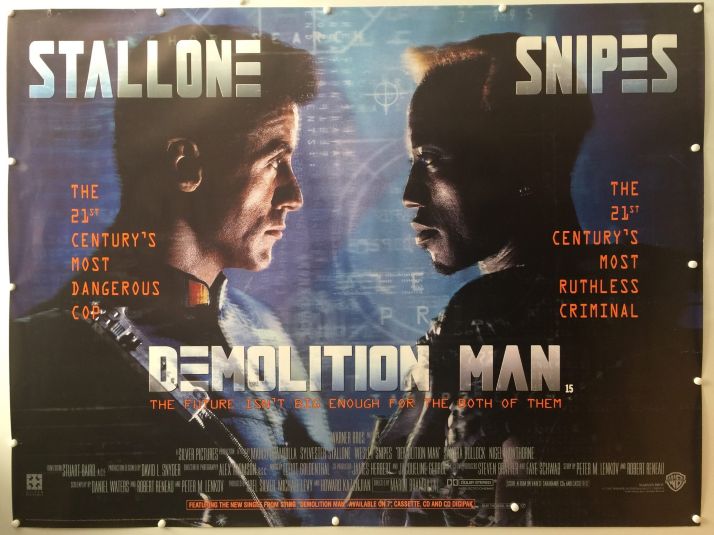
If you remember Sylvester Stallone’s cryogenically frozen cop, Wesley Snipes’ anarchic villain, and Sandra Bullock’s squeaky-clean law enforcer, you might recall that the movie was set in the year 2032, in a sanitised California city where crime had been eradicated, profanity was outlawed, and even romance required official clearance.
Three decades later, we’re close enough to that fictional world to ask: how much of its Orwellian prophecy has come to pass?
Policing by Algorithm
In Demolition Man, police officers carry no guns and respond to crime alerts delivered by a central AI that predicts offences before they happen — a kind of cheerful, bureaucratic version of Minority Report.
Fast forward to today, and predictive policing is not science fiction. From Los Angeles to Nairobi, software now analyses crime data to forecast “hotspots.” Surveillance cameras powered by AI facial recognition quietly track movement through malls, airports, and city streets.
Uganda itself is not untouched: smart CCTV networks installed under the Safe City project already link facial data, vehicle number plates, and traffic flows — tools that both deter crime and raise privacy questions.
The technology works, but Demolition Man’s warning rings clear: who controls the algorithm, and who ensures its fairness? In the film, safety is absolute, but freedom is a casualty. Real life, we’re learning, is much the same balancing act.
Crime Without Criminals
 In the 1993 film, “San Angeles” (a merger of Los Angeles, San Diego, and Santa Barbara) has virtually no crime — not because people are better, but because they’re constantly watched and conditioned to behave. Even bad language triggers a fine from a wall-mounted “verbal morality sensor.”
Sound familiar?
In parts of the world, digital speech policing already happens in real time. Algorithms flag “offensive” posts, and social media moderation bots shadow our words more efficiently than any futuristic morality machine.
The promise of a “clean society” is no longer utopian — it’s coded into our platforms. The tension between civility and censorship is the new frontier. As Demolition Man cheekily predicted, we’re still negotiating what it means to be “good” in an age where machines enforce manners.
Cryogenic Justice and the Prison of Tomorrow
Stallone’s cop, John Spartan, and Snipes’ criminal, Simon Phoenix, are both sentenced to cryogenic imprisonment — frozen solid until society deems them ready for release. In 1993, this idea was absurdly futuristic; in 2025, it’s metaphorically true.
Today’s prisons may not use ice, but they increasingly rely on digital incapacitation. Offenders can be confined by ankle monitors, tracked by GPS, and banned from entire virtual spaces. Courts now issue digital restraining orders, and parole hearings use AI risk assessments to gauge “rehabilitation probability.”
Even the language has softened: we talk of “correctional ecosystems” and “re-entry frameworks” instead of “punishment.” What Demolition Man got right is the notion that the future of incarceration would be technological, bureaucratic, and clinical, not brutal.
The question it leaves us with is chilling. When rehabilitation becomes software, what happens to redemption?
Romance Without Touch

Virtual intimacy
One of the film’s funniest scenes has Bullock’s character inviting Stallone’s Spartan to “make love.” He eagerly accepts, only to find himself wearing a virtual reality headset. Physical contact has been outlawed due to “fluid transfer bans.”
Thirty years ago, that was comedy. Then came COVID-19. Suddenly, intimacy through screens, dating apps, and digital avatars became not just normal — but necessary.
While no one yet fines people for shaking hands, the metaverse’s flirtations and VR companionship hint that Demolition Man’s sterilised affection wasn’t entirely far-fetched. The technology that once connected us now increasingly mediates us. Romance, too, has an algorithmic interface.
A Clean, Convenient, Controlled Future
The film’s San Angeles is a pastel paradise where even Taco Bell is haute cuisine and every need is automated. Yet beneath the cleanliness lies cultural conformity — and a rebellious underclass living in the sewers, scavenging old music and greasy food.
That tension is eerily current. In 2025, the world’s cities are chasing “smart” utopias — cashless payments, biometric ID systems, digital governance — all promising efficiency, all built on surveillance.
But the “sewer people” of today are not criminals; they’re those who simply prefer privacy: cash users, off-grid dwellers, and analogue romantics. Like Demolition Man’s rebels, they resist the algorithm’s embrace — not to break the law, but to keep a piece of their humanity.
 The Past Imagined the Future, and Got Close Enough
Watching Demolition Man now feels less like science fiction and more like retro prophecy. The jokes about toilet-paper-less bathrooms (“the three seashells”) still amuse, but its satire of a world tamed by convenience and control cuts deeper in 2025.
We haven’t frozen criminals or banned kissing — yet — but we’ve automated ethics, outsourced judgment to code, and blurred the line between safety and submission.
Perhaps that’s why the film remains oddly comforting: it laughs at the idea that civilisation can be perfected, and reminds us that rebellion, disorder, and even imperfection, are part of what keeps us human.
So Will the Rest Come True?
Maybe. Cryogenic prisons and VR love aren’t entirely beyond reach. But as AI grows more predictive, and as governments adopt ever more “data-driven” control systems, it’s clear we’re already halfway to Stallone’s frozen future — minus the seashells.
The past didn’t just imagine the future. It warned us. The real question for 2025 is whether we’re listening, or whether we’re too busy enjoying how safe and convenient everything feels to notice that the Demolition has quietly begun.
Related Posts
 KPMG flags widening execution gap as tech leaders bet on AI maturity, talent and partnerships
 Kiira Motors’ Pearl to Cape Expedition delivers 820-bus order pipeline, recasting Africa’s electric mobility narrative
 Pearl to Cape electric expedition crosses 81pc mark as Kayoola E-Coach delivers hard performance data
 Kayoola’s Pearl to Cape odyssey eases Uganda’s electric mobility into a maturity phase
 Africa faces surge in AI fraud as deepfakes redefine identity threats, Sumsub warns
 Crypto uptake outpaces cyber safeguards across Africa, experts warn
Get business news delivered to you everyday
Latest News

Equity Bank Uganda set to close 2025 on firmer footing as clean-up phase gives way to growth

Stanbic targets wider access to affordable financing with ‘Oli In Charge’ campaign

USA–Canada certification dispute could expose Uganda and regional airlines to regulatory risk

Sumsub launches AI Agent Verification as Africa grapples with surge in AI-driven fraud

The hidden cost of blocked airline funds

KPMG flags widening execution gap as tech leaders bet on AI maturity, talent and partnerships

Uganda targets 200,000 visitors for 2026 National Agricultural Show in Jinja

Destination Uganda clinches “Best in Show – Africa” at New York Travel & Adventure Show

Uganda’s Kibirige edges closer to global golf stage after strong PGTI Q-School showing in India

Breathtaking Uganda unveils curated Easter getaway to Zanzibar