

Mugisha urges Ugandan engineers to prioritise innovation over dependence
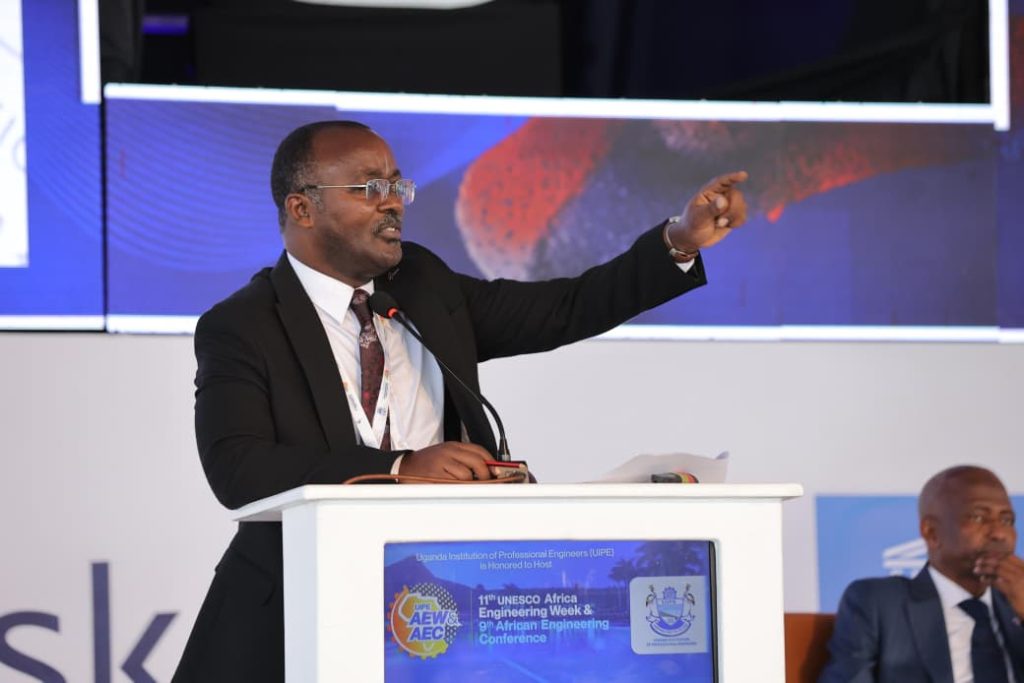
NWSC chief Dr. Silver Mugisha has called on Ugandan engineers to prioritise innovation and self-reliance, warning that dependence on foreign expertise undermines internal resilience. Speaking at the 2025 Africa Engineering Week, he pointed to NWSC’s digital systems and local artisan ingenuity as proof that homegrown solutions can power growth and resilience.
The managing director of Uganda’s National Water and Sewerage Corporation (NWSC), Dr. Silver Mugisha, has challenged Ugandan engineers to embrace innovation and self-reliance, arguing that the country’s future resilience will depend on homegrown solutions rather than imported technologies.
Speaking at the 2025 Africa Engineering Week, Mugisha argued that engineers must evolve from their traditional design roles into innovators who deliver practical, market-ready technologies. He cited NWSC’s transformation over the past decade as proof of what can be achieved by building internal capacity.
Since 2013, NWSC has expanded from 23 to over 282 serviced towns, while annual surpluses grew from UGX 34 billion to UGX 150 billion. Mugisha attributed part of this performance to the corporation’s decision to develop billing, payment, and digital systems in-house—a move that has cut costs, reduced dependency on foreign vendors.
That strategy, he explained, has also strengthened resilience against cyber threats. When NWSC recently faced a hacking incident, its internally developed systems were restored within two days, while outsourced solutions took months to recover.
“When NWSC was hacked recently, our internally developed systems were restored in two days, while outsourced solutions took months,” Mugisha said, pointing to the business case for self-reliance.
He challenged engineers to adopt a reverse engineering mindset, learning how existing technologies work and adapting them for Uganda’s market needs. As an example, he highlighted the artisans of Katwe, who build maize mills and other machinery without formal training, and local innovators who successfully created a helicopter prototype.
“It is not formal degrees that matter in creating engineering solutions,” Mugisha noted. “We who excelled at school have succeeded a lot in using our knowledge to design things, but in innovation—not much.”
The conference, organized by the Federation of African Engineering Organizations (FAEO), brought together engineers from across the continent to explore how African innovation can power industrial growth, infrastructure development, and digital transformation.
Related Posts
 KPMG flags widening execution gap as tech leaders bet on AI maturity, talent and partnerships
 Kiira Motors’ Pearl to Cape Expedition delivers 820-bus order pipeline, recasting Africa’s electric mobility narrative
 Pearl to Cape electric expedition crosses 81pc mark as Kayoola E-Coach delivers hard performance data
 Kayoola’s Pearl to Cape odyssey eases Uganda’s electric mobility into a maturity phase
 Africa faces surge in AI fraud as deepfakes redefine identity threats, Sumsub warns
 Crypto uptake outpaces cyber safeguards across Africa, experts warn
Get business news delivered to you everyday
Latest News

Equity Bank Uganda set to close 2025 on firmer footing as clean-up phase gives way to growth

Stanbic targets wider access to affordable financing with ‘Oli In Charge’ campaign

USA–Canada certification dispute could expose Uganda and regional airlines to regulatory risk

Sumsub launches AI Agent Verification as Africa grapples with surge in AI-driven fraud

The hidden cost of blocked airline funds

KPMG flags widening execution gap as tech leaders bet on AI maturity, talent and partnerships

Uganda targets 200,000 visitors for 2026 National Agricultural Show in Jinja

Destination Uganda clinches “Best in Show – Africa” at New York Travel & Adventure Show

Uganda’s Kibirige edges closer to global golf stage after strong PGTI Q-School showing in India

Breathtaking Uganda unveils curated Easter getaway to Zanzibar