

Entebbe International Airport hands over 8.8 tonnes of confiscated wildlife contraband to UWA
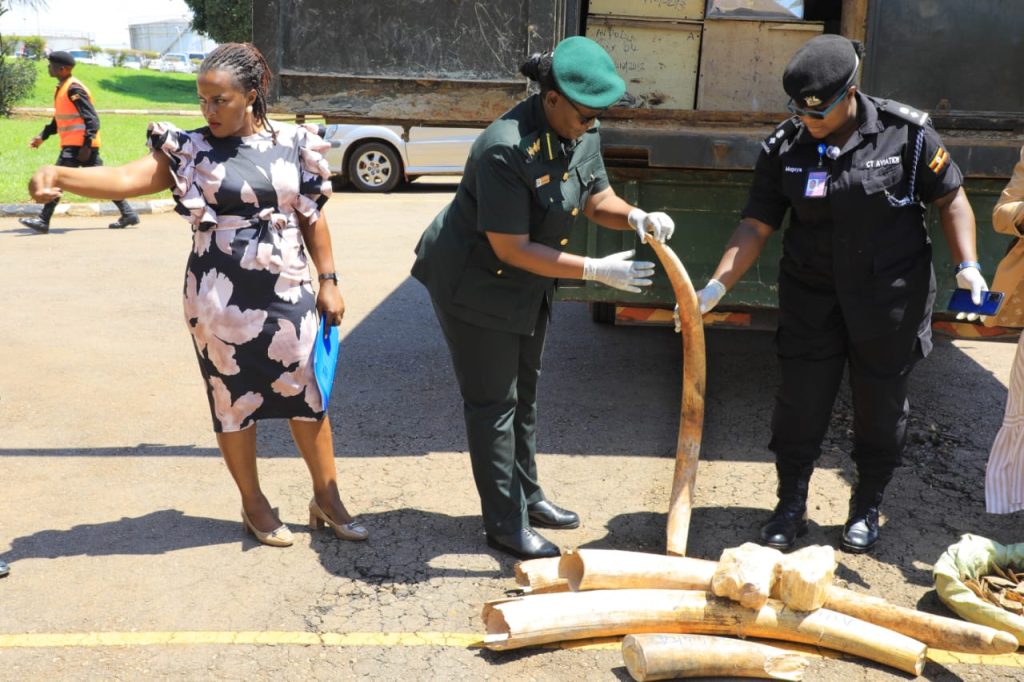
More than 8.8 tonnes of ivory, pangolin scales, rhino horns and other wildlife contraband seized at Entebbe International Airport over the past 15 years have been handed over to the Uganda Wildlife Authority. The transfer underscores Uganda’s growing success in using airport security systems and inter-agency cooperation to combat international wildlife trafficking.
More than 8.8 tonnes of wildlife products confiscated at Entebbe International Airport over the last 15 years have been formally handed over to the Uganda Wildlife Authority (UWA), highlighting the critical role airports play in the fight against transnational wildlife trafficking.
The exhibits, weighing a total of 8,857.84 kilogrammes, were transferred from the Aviation Police at Entebbe International Airport to UWA during a handover ceremony held on June 5, 2026.
The stockpile includes a wide range of endangered and protected wildlife products such as raw and worked ivory, pangolin scales, rhino horns, hippopotamus teeth, skins, lion teeth and ostrich eggshells. The items had been seized through joint operations involving Aviation Police, UWA and other security agencies since 2011.
Speaking during the handover, Assistant Commissioner for Law Enforcement at UWA, Margaret Kasumba, who represented the Executive Director, commended Aviation Police and other security agencies for preserving the exhibits over the years.
Kasumba said the confiscated items had been securely maintained and accurately recorded in UWA’s inventory system, ensuring accountability throughout the period they remained in police custody.
“The successful preservation of these exhibits demonstrates the commitment of our partner agencies in supporting wildlife conservation and law enforcement efforts,” she said.
Authorities revealed that traffickers had employed increasingly sophisticated concealment methods to evade detection. In some cases, wildlife products were hidden in containers labelled as shea butter, underscoring the evolving tactics used by organised criminal networks involved in the illegal wildlife trade.
Security officials noted that enhanced screening measures introduced at Entebbe International Airport, including the deployment of a specialised canine unit in 2018, have significantly strengthened efforts to detect prohibited wildlife products and other illicit cargo.
Superintendent of Police Irene Mugoya, representing the Commandant of Aviation Police, thanked UWA for agreeing to take over custody of the exhibits and praised the joint verification exercise conducted by the two institutions.
According to Mugoya, an inventory undertaken during the handover process confirmed that all exhibits remained intact and properly accounted for.
She noted that while some of the seized wildlife products originated from Uganda, the majority were traced to neighbouring countries and were being trafficked through Entebbe as part of international smuggling routes.
The handover exercise began on May 19, 2026 under the leadership of UWA’s Assistant Commissioner for Law Enforcement.
The development highlights the growing importance of airports as frontline defence points against wildlife crime, which remains one of the world’s most lucrative forms of illegal trafficking.
Uganda Civil Aviation Authority (UCAA) Manager for Public Affairs, Vianney Luggya, said the successful interception and preservation of the exhibits reflected the effectiveness of the airport’s security and screening systems.
“This handover is a testament to the effectiveness of the security, screening and enforcement mechanisms in place at Entebbe International Airport to detect and intercept prohibited and illegally trafficked items,” Luggya said.
“It demonstrates the strong collaboration among the various government agencies responsible for safeguarding Uganda’s borders and protecting global wildlife resources.”
Luggya warned criminal syndicates against attempting to use Entebbe International Airport as a transit point for illegal wildlife products or other prohibited items.
“We wish to caution all individuals and criminal networks that may intend to use Entebbe International Airport as a transit point for illegal wildlife products or any other prohibited items that such attempts will be detected and dealt with in accordance with the law,” he said.
“The airport’s surveillance, screening and enforcement systems remain robust, and offenders will face the full force of the law.”
Wildlife trafficking remains a major conservation and security challenge globally, driven by international demand for ivory, rhino horn and other wildlife products. Conservation experts say sustained cooperation between aviation authorities, law enforcement agencies and wildlife regulators is essential to disrupting trafficking networks that exploit regional transport corridors.
The latest handover reinforces Uganda’s efforts to strengthen border security while contributing to global campaigns aimed at protecting endangered species from illegal exploitation.
Related Posts
 Independence Marathon Turns to Blood Storage Gap in Maternal Health Drive
 Fine Spinners Injects Fresh USD5m Into Technology as Uganda Textile Maker Targets African, European Markets
 Equity Trade Mission Puts Uganda’s Manufacturing Capacity to Regional Test
 Uganda Seeks to Calm Coffee, Cocoa Markets as Global Prices Fluctuate on Positive Sentiment
 Uganda Green Entrepreneurs Set for Paris Visit as Stanbic-France Partnership Graduates 106
 Entebbe Airport Passenger Traffic Recovers in August but Remains Below 2025 Levels
Get business news delivered to you everyday
Latest News

Independence Marathon Turns to Blood Storage Gap in Maternal Health Drive

Fine Spinners Injects Fresh USD5m Into Technology as Uganda Textile Maker Targets African, European Markets

Equity Trade Mission Puts Uganda’s Manufacturing Capacity to Regional Test

Uganda Seeks to Calm Coffee, Cocoa Markets as Global Prices Fluctuate on Positive Sentiment

Uganda Green Entrepreneurs Set for Paris Visit as Stanbic-France Partnership Graduates 106

Nile Breweries, Next Media Renew Road Safety Push with Focus on Boda Boda Riders

Equity Bank Explores Value-Chain Financing to Support Zigoti Coffee Expansion

Uganda Breaks Ground on USD310m Kampala Fuel Terminal, Targets September 2028 Completion

Uganda Will Not Close Its 2.4-Million-Unit Housing Deficit with Ribbon-Cuttings in Kira

Nairobi’s 2029 World Athletics Win Draws Doping Scrutiny in UK Media