

Can the Uganda Shilling Recover Lost Ground? History suggests it can, but oil will test the Bank of Uganda
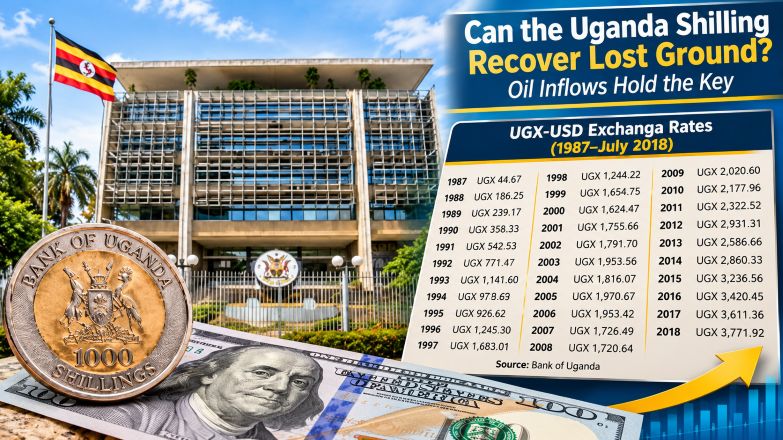
The shilling’s latest slide has revived concerns about the country’s currency outlook. Historical exchange-rate movements, however, show that depreciation is not necessarily a one-way journey. As Uganda approaches commercial oil production, the bigger question may be how to manage a stronger shilling without undermining exporters and domestic production.
Michael Wakabi
The recent rapid depreciation of the Uganda shilling against the Greenback has renewed old anxieties about the prospects of the local unit and whether each successive bout of depreciation represents another permanent loss of value.
For a largely import-dependent economy, the repercussions have been swift. Households are feeling the pressure through higher prices of imported goods, while businesses with dollar-denominated obligations face rising repayment costs.
Yet the assumption that the shilling can only continue on a downward spiral is not entirely supported by Uganda’s exchange-rate history. Historical data published by the Bank of Uganda, covering the period from 1987 to July 2018, shows that the currency has experienced episodes of sharp plunges followed by meaningful recoveries.
The data suggest that, although the long-term direction has been towards a weaker shilling, the exchange rate has never been an uninterrupted one-way journey. That matters because Uganda is approaching a potentially significant change in its foreign-exchange earnings profile.
The imminent start of commercial oil production and exports is expected to introduce a new source of dollar inflows into an economy that has traditionally depended on agricultural exports, re-exports, tourism, remittances, foreign investment and development financing to support its foreign-currency requirements. While that prospect raises the possibility of a stronger shilling, it also presents the Bank of Uganda with a different set of policy challenges.
The historical figures provide an interesting perspective on the current debate. In 1987, the dollar exchanged for UGX44.67. By 1992, it required UGX1,145.43, reflecting the severe currency volatility and economic disruption of the preceding years. Just a year earlier, the shilling had been trending at UGX749.58 to the dollar. The exchange rate subsequently moved to UGX1,195.02 in 1993 before clawing lost ground to UGX979.45 in 1994; a significant recovery within a relatively short period. The currency strengthened further to UGX968.65 in 1995.
The 1994–1997 recovery was closely associated with the coffee boom of 1994–1996, when improved export earnings increased the supply of foreign currency in the domestic market. The resulting strength of the shilling was so pronounced that the Bank of Uganda at one point had to intervene in support of the US dollar to moderate the currency’s appreciation.
The movement demonstrates that even after substantial depreciation, the shilling has previously regained considerable ground when economic and monetary conditions changed.
A second period of appreciation occurred in the middle mid-2000s. Having weakened to UGX1,963.68 against the dollar in 2003, the shilling strengthened to UGX1,810.77 in 2004 and UGX1,780.67 in 2005. It subsequently weakened again, reaching UGX1,831.45 in 2006, before recovering to UGX1,723.49 in 2007 and Shs1,720.44 in 2008.
These episodes illustrate two important characteristics of Uganda’s foreign-exchange market. First, the exchange rate responds to changing economic fundamentals rather than following a predetermined path. Second, periods of appreciation can be relatively short-lived where the underlying sources of foreign-exchange supply and demand are not sustainably balanced.
The longer-term picture nevertheless reveals the extent of the shilling’s depreciation. By 2018, the dollar was exchanging at UGX3,717.42, more than 83 times its 1987 rate.
While this historical comparison should not be interpreted as a forecast of future exchange rates or that the conditions responsible for earlier recoveries will necessarily recur; it challenges the notion that the shilling has no capacity to recover.
What is driving the latest weakness?
The recent depreciation is best understood in the context of global dollar movements and Uganda’s domestic foreign-exchange requirements.
The Ministry of Finance’s October 2026 Performance of the Economy report shows that the shilling depreciated by 7.8 per cent during the month, with the average mid-rate moving from UGX3,868.87 per dollar in September to UGX4,170.48.
The report attributes the pressure to reduced foreign-exchange inflows, including weaker portfolio investment, lower international prices for agricultural exports, particularly coffee, and reduced tourism earnings.
At the same time, the cost of financing imports has risen, particularly petroleum products, following increases in international oil and shipping costs. Demand for dollars has also remained strong from the energy and manufacturing sectors.
This is a familiar structural vulnerability. While Uganda’s demand for foreign currency is closely connected to its import requirements, the supply side depends on the performance of a relatively concentrated range of export and service sectors, alongside remittances and capital flows. When export earnings and other inflows weaken at the same time that import payments increase, pressure on the exchange rate becomes difficult to avoid.
Global monetary conditions add another layer as higher interest rates in advanced economies make dollar-denominated assets more attractive to international investors, encouraging portfolio flows away from emerging and frontier markets.
The implication of this is that Uganda’s currency outlook cannot be determined by domestic monetary policy alone. Even a relatively high domestic interest rate may not fully offset global shifts in investment preferences, higher import costs and changes in the availability of export proceeds.
Could Oil Reciepts Change the Equation
The anticipated oil revenues offer perhaps the strongest reason to for optimism about the shilling’s longer-term prospects. Unlike agricultural exports, whose earnings fluctuate with weather, production cycles and international commodity prices, petroleum exports could introduce a substantial additional stream of foreign currency once commercial production and exports begin. It could also change the country’s balance of foreign-exchange supply and demand.
The Ministry of Finance has identified the commencement of commercial oil production and exports as a factor expected to strengthen Uganda’s foreign-exchange earnings and external position over the medium term.
However, it would also be premature to assume that oil production will automatically translate into a stronger shilling.
The petroleum sector will itself require substantial foreign-currency expenditure, including payments for imported equipment, specialised services, financing obligations and other operational costs. The extent to which export earnings translate into additional dollars available to the domestic economy will partly depend on how much foreign currency remains in the country and how the proceeds are managed.
There is also the question of timing. Oil-related investment and construction expenditure can generate significant demand for foreign exchange before export revenues begin flowing in at scale.
The net effect will therefore depend on the balance between export receipts, sector-related foreign-currency expenditure and the government’s management of petroleum revenues.
The Challenge of Managing Appreciation
A stronger shilling would bring welcome relief to importers and consumers. Businesses importing machinery, industrial inputs, fuel and other goods would require fewer shillings to purchase the same amount of dollars. It could also help contain imported inflation, particularly if appreciation is sustained and reflected in domestic prices.
But while exchange-rate appreciation might reduce the cost of imports, it does not automatically reverse domestic price increases. That partly depends on how much of the currency movement businesses pass through to consumers.
Also, for exporters, a sudden appreciation can reduce the domestic-currency value of foreign earnings. A coffee exporter receiving USD1 million, for instance, would receive fewer shillings when converting those proceeds if the exchange rate moved from UGX4,000 to UGX3,500 per dollar.
Unless export prices or productivity improve sufficiently to compensate, the resulting reduction in shilling revenues could squeeze margins and discourage investment. The effect could extend beyond traditional agricultural exports to tourism, manufacturing and other businesses competing in international and regional markets.
This presents a policy dilemma. Uganda needs the foreign-exchange inflows that oil exports will generate, but an abrupt appreciation driven by concentrated petroleum earnings could undermine the competitiveness of other productive sectors.
The experience of other resource-rich economies offers useful lessons. Large foreign-exchange inflows from natural resources can push up the value of a country’s currency, making other exports less competitive. Economists commonly call this phenomenon the “Dutch disease.”
For Uganda, the concern would be particularly relevant if oil revenues strengthen the shilling without a corresponding improvement in productivity, infrastructure, technology and the competitiveness of non-oil industries.
The challenge, therefore, will not simply be to welcome a stronger currency but to ensure that appreciation does not come at the expense of economic diversification.
 What can the Bank of Uganda do?
The Bank of Uganda has several instruments available to manage excessive exchange-rate volatility and the domestic liquidity implications of large foreign-currency inflows. One option is to purchase foreign currency from the market and add it to international reserves. This would absorb some of the additional dollar supply, helping to moderate appreciation while strengthening the country’s capacity to meet external obligations.
However, purchasing dollars injects additional shillings into the domestic financial system. Since the primary instrument is selling government paper, sucking excess liquidity from the market to dampen inflationary pressures, could push up the cost of domestic credit. Sterilisation would therefore come at a cost.
Another option is staggering inflows of government oil revenues. Rather than allowing large receipts to enter the domestic economy at once, a structured approach to saving and spending petroleum earnings could help smooth their impact on the exchange rate.
This is where alignment between fiscal and monetary policy becomes critical. A well-managed petroleum revenue framework would allow government to convert oil wealth into productive investment over time, rather than creating sudden spending pressures that distort the exchange rate and domestic economy.
The logical approach should be to preserve macroeconomic stability while ensuring that oil revenues contribute to productive capacity. There is already evidence of the Bank of Uganda’s willingness to use monetary policy more actively when exchange-rate pressures threaten price stability. In October 2026, the central bank raised its Central Bank Rate by 225 basis points, from 9.75 per cent to 12 per cent, partly in response to depreciation and the inflationary risks associated with higher energy prices. The subsequent decision to maintain the rate at 12 per cent in November, while tightening liquidity conditions, illustrates the balancing act facing monetary authorities.
Recovery will Depend on More Than Oil
Ultimately, the shilling’s ability to regain lost ground and hold firm, will depend on whether the central bank can build a more resilient foreign-exchange position. Oil exports could provide a welcome boost, but sustainable currency strength is going to require diversification and expansion of foreign-exchange-generating activities. Agricultural exports, tourism, manufacturing, mineral exports, remittances and services must all contribute to a more diversified supply of foreign currency.
The country also needs to address the structural factors that sustain demand for dollars, including dependence on imported industrial inputs, petroleum products, machinery and consumer goods. Until a domestic oil refinery is built, the country will continue to import refined petroleum products.
This should not be seen as an imperative for import substitution at any cost, but a case for strengthening domestic production and value addition so that economic expansion does not translate into an ever-growing import bill.
The historical exchange-rate data offers a useful reminder that the shilling has recovered before. But the more important lesson is that currency appreciation is most sustainable when supported by stronger productive capacity, export competitiveness and sound economic management.
The question, therefore, is not whether the Uganda shilling can recover lost ground. History suggests that it can. Uganda’s challenge may eventually shift from defending the shilling against depreciation to managing appreciation without eroding the competitiveness of its other export sectors.
Related Posts
 Equity Bank wins 2026 Bancassurance Award as Lender Captures 9pc of Market
 Air Tanzania Wires 15 Airports to Support Global Communications
 BRENDA NANYONJO: Quietly Raising a Generation of Ugandan Female Champions
 TAP, PAY, DONE: How Young Africans are Shaping a More Frictionless Payment Future
 Museveni Seeks Tanzania Backing to Curb Second-hand Clothes Imports
 UCU Invites Investors for USD110million Campus Infrastructure Project
Get business news delivered to you everyday
Latest News

Can the Uganda Shilling Recover Lost Ground? History suggests it can, but oil will test the Bank of Uganda

Equity Bank wins 2026 Bancassurance Award as Lender Captures 9pc of Market

Air Tanzania Wires 15 Airports to Support Global Communications

Stanbic Expands Brick and Mortar Branch Network to 84 with Naalya Outlet

BRENDA NANYONJO: Quietly Raising a Generation of Ugandan Female Champions

TAP, PAY, DONE: How Young Africans are Shaping a More Frictionless Payment Future

Museveni Seeks Tanzania Backing to Curb Second-hand Clothes Imports

Equity Group Sustains Earnings Momentum as Q3 Profit Rises 32pc

SITA Survey finds Travel Stress Deterred 42pc of Passengers from Booking Trips

Employee Protection Becomes a Balance-sheet Issue for Ugandan Businesses