

Africa faces surge in AI fraud as deepfakes redefine identity threats, Sumsub warns

The Sumsub Identity Fraud Report 2025–2026 shows Africa’s digital boom is accompanied by a shift from traditional scams to high-skill, AI-driven fraud, including deepfakes and synthetic identities.
Africa’s digital economy is booming, but its rapid expansion is transforming the fraud landscape and raising threat levels, prompting a need for more agile risk mitigation digital identity verification firm Sumsub says in its Identity Fraud Report 2025–2026.
The report highlights a sharp transition where traditional document fraud and low-effort scams are declining across the continent but AI-driven attacks — from deepfakes to synthetic identities and post-KYC account abuse — are on the rise, challenging both businesses and regulators.
“AI reshapes both offence and defence. Attackers gain deepfakes, synthetic IDs, and autonomous fraud agents; defenders gain behaviour modelling, millisecond anomaly detection, and self-learning systems. The next frontier is verification of AI agents themselves — confirming not just who you are, but who acts on your behalf,” said Pavel Goldman-Kalaydin, Head of AI/ML (artificial intelligence/machine learning) at Sumsub.
The report notes striking trends in major markets. Nigeria recorded a 54pcdrop in overall fraud, Algeria 60pc, Kenya 42pc, and South Africa 31pc, with South Africa now at a 1.4pc fraud rate thanks to advanced verification systems. Yet deepfake incidents tell a different story. South Africa saw a 269pc increase, while Zambia experienced a staggering 967pc surge. In Kenya, deepfakes now make up nearly 10pc of all fraud attempts. Across Africa, one in five people report being targeted by deepfakes, and 24pc admit they cannot reliably distinguish manipulated content.
“The Sophistication Shift is evident across the continent. Fraudsters are moving from high-volume, low-effort scams to highly targeted, AI-driven operations. At the same time, African businesses and regulators are innovating fast, with enhanced SIM–ID linkages, behavioural analytics, and cross-border cooperation,” says Hannes Bezuidenhout, Sumsub VP for Sales Africa. “Africa’s story is not only about exposure — it is about resilience, innovation, and a shared commitment to building digital trust from the ground up.”
Even in markets showing progress, new risks persist. Nigeria’s overall fraud fell dramatically, but AML-related fraud remains elevated at 4pc, reflecting attackers’ pivot to sophisticated, AI-enabled techniques. Consumers are also increasingly selective with 92pc of Africans surveyed only trusting service providers with visible anti-fraud measures. Finance, travel, and e-commerce platforms are the most trusted, while social media, crypto, and dating platforms face scepticism.
Businesses report high levels of both first-party and third-party fraud, including account takeovers, phishing, and synthetic identity misuse. Nearly nine in ten organisations acknowledge the rising sophistication of fraud, with 76pc observing more organised, cross-border attacks.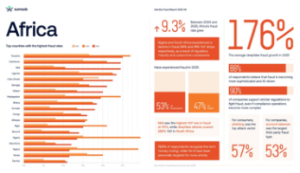
Recent regional cases underscore the stakes. Mozambique sentenced its former Finance Minister to 8.5 years in jail for a USD2 billion cross-border fraud. INTERPOL’s Operation Serengeti 2.0 dismantled cybercrime networks across 18 African countries, recovering USD97.4 million. In West Africa, human trafficking-linked scam centres are exploiting AI-generated visuals and autonomous chatbots to manipulate victims.
Looking ahead, Sumsub forecasts a new era of AI-driven fraud in 2026. “Identity verification is entering a new phase — one where automation, AI and data fusion converge,” said Sumsub CTO (Chief Technology Officer) Vyacheslav Zholudev. He added, “The next breakthroughs won’t come from better document scanning, but from AI agents verifying other AI agents.” As digital assistants increasingly transact on behalf of users, businesses will need systems capable of verifying both the human and the autonomous entity acting in their name.
The report warns that fragmented compliance systems will no longer suffice. Continuous behavioural analytics, device telemetry, and contextual intelligence will form the backbone of future anti-fraud infrastructure. Money-mule networks, AI-coordinated fraud rings, and voice-spoofing attacks are expected to multiply, particularly in lower-literacy markets.
Africa is not merely reacting; it is helping define global fraud-prevention standards. With national ID–SIM integration, behavioural biometrics, regional collaboration, and modernised regulatory frameworks, the continent is at the forefront of a new fight where identity, trust, and security are continually contested between sophisticated AI-driven attackers and defenders.
Related Posts
 Stanbic rolls out direct Yuan settlements as Standard Bank links Africa to China’s CIPS network
 Kenya Airways issues profit warning as supply chain snags ground widebody fleet
 Crypto uptake outpaces cyber safeguards across Africa, experts warn
 US moves to reassert influence in Africa through $150m Zipline drone partnership
 UDB opens Hoima branch to deepen access to development finance in Bunyoro
 Air Senegal’s financial troubles escalate as french bank moves to seize two A330neos
Get business news delivered to you everyday
Latest News

Africa leads global air cargo surge as demand jumps 16.6pc in October — IATA

Stanbic rolls out direct Yuan settlements as Standard Bank links Africa to China’s CIPS network

Kenya Airways issues profit warning as supply chain snags ground widebody fleet

Africa faces surge in AI fraud as deepfakes redefine identity threats, Sumsub warns

African lawyers urged to lead in competition law and cross-border deals

Uganda, Kenya push for smoother borders at 14th JBC meeting in Jinja

Stanbic staff donate ICT equipment and supplies to Masaka School for the Deaf

Crypto uptake outpaces cyber safeguards across Africa, experts warn

US moves to reassert influence in Africa through $150m Zipline drone partnership

UDB opens Hoima branch to deepen access to development finance in Bunyoro