

Ugandan scientists rise to the challenge as climate change threatens livelihoods
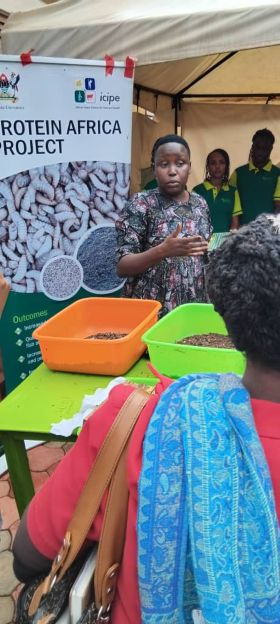
From insect-based animal feed to turning surplus tomatoes into powder, Ugandan scientists and innovators are rolling out climate-smart solutions that could reshape agriculture in the face of climate change.
These are some of the innovations that were showcased during the Uganda Climate Smart Agriculture Multi-Stakeholder Platform (UG-CSA-MSP) Annual Review, held at the Hilton Garden Inn in Kampala from September 15–19, 2025. The five-day event brought together government, researchers, the private sector, innovators, and farmer organisations to assess progress and set priorities for the next year. Convened under the Association for Strengthening Agricultural Research in Eastern and Central Africa (ASARECA), it also served as a forum for reporting on Uganda’s Agriculture National Adaptation Plan (Ag-NAP), a cornerstone of the country’s Paris Agreement commitments.
Like elsewhere in Africa, Ugandan agriculture faces threats ranging from erratic rainfall, prolonged droughts, and soil degradation. Yet scientists are responding with practical solutions.
Dr. Dorothy Amulen, through her Centre for Insect Research and Development, is training farmers to rear black soldier fly larvae as a substitute for dwindling silver fish, once a critical protein source in poultry feed. “The project has not only stabilised feed costs but also boosted productivity,” she said.
Hannington Lwandasa, the founder of Dani Agro Limited, is helping tomato growers in Luwero, Nakaseke and Kayunga districts tackle the perennial problem of postharvest losses. By bulking and processing tomatoes into powder form, farmers can sell at predictable prices, while schools and institutional consumers gain access to predictable quality at stable supplies. The model ensures farmers are paid by weight, regardless of size or grade.
At the Kawanda Agricultural Research Station, researchers are testing soil management techniques that retain moisture and conserve fertility under harsh weather. Elsewhere, another group of researchers is breeding high-quality primary soybean seed to strengthen a vital food and feed value chain.
Collaboration as the Key Driver

Dr Joshua Okonya
“The task of transforming Africa’s agriculture is so complex that it cannot be undertaken by a single institution,” Dr. Joshua Okonya, ASARECA Program Officer for Agricultural Technology and Innovation told stakeholders. “That is why we must work together across stakeholder platforms to ensure innovations actually reach farmers.”
Launched in 2023 and hosted by the Ministry of Agriculture, Animal Industry and Fisheries (MAAIF), the Uganda CSA-MSP coordinates state and non-state actors, mobilises resources, and strengthens reporting on Uganda’s Nationally Determined Contributions (NDCs).
Julian Barungi, ASARECA Policy Officer, stressed the global context: “We want to strengthen the platform’s capacity to track progress towards the Paris Agreement. That means not just documenting innovations, but also advocating for enabling policies and functional markets.”

Julian Barungi
The Kampala meeting focused on embedding CSA activities into institutional plans and budgets. Stakeholders nominated members to technical working groups and explored new funding models and technical backing to scale up proven solutions.

Dr John Recha
Still, uptake remains uneven. Dr. John Recha, a Climate-Smart Agriculture Scientist at the International Livestock Research Institute who is involved in the World Bank–funded Accelerating Impacts of CGIAR Climate Research for Africa (AICCRA) project, noted that while Africa has generated many CSA innovations, adoption is hampered by low awareness and policy barriers. “This needs deeper stakeholder engagement to address,” he said.
Beyond the plenary, participants toured CSA sites in Wakiso where they observed zero-waste farming systems, and homegrown climate adaptation measures in action.
The review was supported by AICCRA, the Uganda Climate-Smart Agricultural Transformation Project (UCSATP), the ASARECA CSA Alliance (ACSAA), and SNV’s CRAFT Project.
Towards a Climate-Resilient Future
For a country where agriculture employs nearly 70 percent of the population and contributes a quarter of GDP, the stakes are high. Climate variability is already cutting yields, eroding rural incomes, and undermining food security. Without adaptation, the consequences could be severe.
But the momentum is building. From insect-based feeds that cushion farmers against market shocks to soil practices that safeguard crops, Ugandan innovations are proving that resilience is possible.
The challenge now is scale—mobilising resources, embedding CSA in policy, and ensuring grassroots farmers can access these technologies.
ASARECA summarised the expected outcome: “The review will improve coordination and reporting while helping Uganda advance holistic approaches to agriculture, food systems, and food security.”
As the meeting closed, the emerging message was that climate-smart agriculture is no longer an experiment but a necessity. Properly scaled, the innovations nurtured under the CSA-MSP could safeguard millions of livelihoods and keep Uganda on track with its global climate commitments.
Related Posts
 Equity Bank Uganda set to close 2025 on firmer footing as clean-up phase gives way to growth
 USA–Canada certification dispute could expose Uganda and regional airlines to regulatory risk
 KPMG flags widening execution gap as tech leaders bet on AI maturity, talent and partnerships
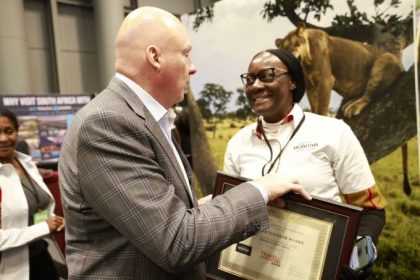 Destination Uganda clinches “Best in Show – Africa” at New York Travel & Adventure Show
 Uganda’s Kibirige edges closer to global golf stage after strong PGTI Q-School showing in India
 Breathtaking Uganda unveils curated Easter getaway to Zanzibar
Get business news delivered to you everyday
Latest News

Equity Bank Uganda set to close 2025 on firmer footing as clean-up phase gives way to growth

Stanbic targets wider access to affordable financing with ‘Oli In Charge’ campaign

USA–Canada certification dispute could expose Uganda and regional airlines to regulatory risk

Sumsub launches AI Agent Verification as Africa grapples with surge in AI-driven fraud

The hidden cost of blocked airline funds

KPMG flags widening execution gap as tech leaders bet on AI maturity, talent and partnerships

Uganda targets 200,000 visitors for 2026 National Agricultural Show in Jinja

Destination Uganda clinches “Best in Show – Africa” at New York Travel & Adventure Show

Uganda’s Kibirige edges closer to global golf stage after strong PGTI Q-School showing in India

IATA, CFM renew agreement to ease engine maintenance bottlenecks as supply chain crisis deepens