

UDB positions Uganda for a bigger green finance role at COP30
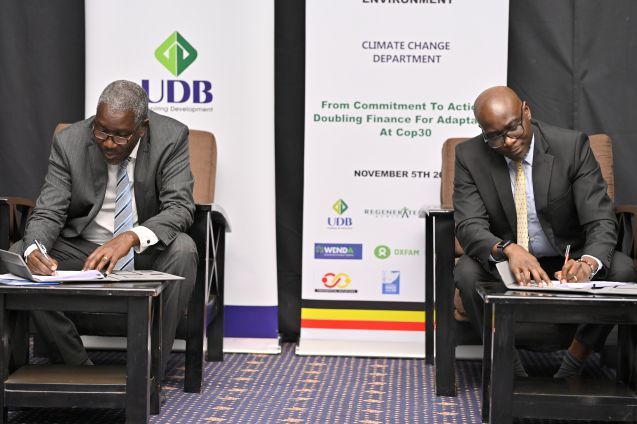
As global leaders gather in the Amazonian city of Belém for the UN Climate Change Conference (COP30), the Uganda Development Bank (UDB) is taking a front-row seat in defining Uganda’s green investment agenda.
Under a new Memorandum of Understanding with the Ministry of Water and Environment, signed just days before the summit, UDB is spearheading efforts to showcase bankable, climate-aligned investment opportunities in renewable energy, green manufacturing, climate-smart agriculture, and sustainable infrastructure — the four pillars of Uganda’s long-term economic transformation.
The Bank is also sponsoring and managing the Uganda Pavilion, which will serve as the central platform for national engagements and investor dialogues throughout the two-week global summit.
This marks the third consecutive COP appearance for UDB, signaling its evolution from a domestic lender to a regional thought leader in climate finance. In the past two years, UDB has built a pipeline of projects valued at over USD 100 million, anchored on partnerships with multilateral climate funds and private-sector investors.
“COP30 presents a unique opportunity to amplify our mandate — to accelerate sustainable socio-economic development through finance and catalyse private sector participation,” said Dr. Patricia Ojangole, UDB’s Managing Director.
Beyond the optics of national representation, UDB’s strategy in Belém is highly transactional. The Bank plans a series of high-level side events focusing on energy efficiency, e-mobility, sustainable waste management, and resilience in the agri-food value chain — all aimed at crowding in concessional finance and risk-sharing partnerships for Uganda’s green projects.
The timing is critical. Uganda’s National Climate Change Policy projects an annual funding requirement of USD 194.5 million to implement its climate commitments over the next 15 years. Yet, inflows remain modest and scattered. Analysts argue that without a structured vehicle for green finance, the country risks missing the economic dividends of the global energy transition.
UDB’s response is the proposed Climate Finance Facility (CFF) — a blended finance instrument designed to mobilize low-cost capital, manage project risks, and on-lend to ventures with measurable environmental and social impact.
Such mechanisms are vital. Uganda’s forest cover has shrunk from 24pc in 1990 to just 12.4pc, while wetland coverage has fallen below 9pc. These losses already carry a high economic cost — eroding agricultural productivity, intensifying floods, and driving up recovery expenditure.
By consolidating Uganda’s presence at COP30 and reframing climate adaptation as an investable opportunity, UDB is signaling that national development banks in Africa must graduate from being passive conduits of donor funds to architects of climate capital.
If Uganda’s message in Belém lands as intended, the country could move from the margins of climate finance to a credible destination for green investment partnerships in the years ahead.
Related Posts
 Equity Bank Uganda set to close 2025 on firmer footing as clean-up phase gives way to growth
 Stanbic targets wider access to affordable financing with ‘Oli In Charge’ campaign
 USA–Canada certification dispute could expose Uganda and regional airlines to regulatory risk
 Sumsub launches AI Agent Verification as Africa grapples with surge in AI-driven fraud
 KPMG flags widening execution gap as tech leaders bet on AI maturity, talent and partnerships
 IATA, CFM renew agreement to ease engine maintenance bottlenecks as supply chain crisis deepens
Get business news delivered to you everyday
Latest News

Equity Bank Uganda set to close 2025 on firmer footing as clean-up phase gives way to growth

Stanbic targets wider access to affordable financing with ‘Oli In Charge’ campaign

USA–Canada certification dispute could expose Uganda and regional airlines to regulatory risk

Sumsub launches AI Agent Verification as Africa grapples with surge in AI-driven fraud

The hidden cost of blocked airline funds

KPMG flags widening execution gap as tech leaders bet on AI maturity, talent and partnerships

Uganda targets 200,000 visitors for 2026 National Agricultural Show in Jinja

Destination Uganda clinches “Best in Show – Africa” at New York Travel & Adventure Show

Uganda’s Kibirige edges closer to global golf stage after strong PGTI Q-School showing in India

Breathtaking Uganda unveils curated Easter getaway to Zanzibar