

Slow structural transformation hinders East African growth
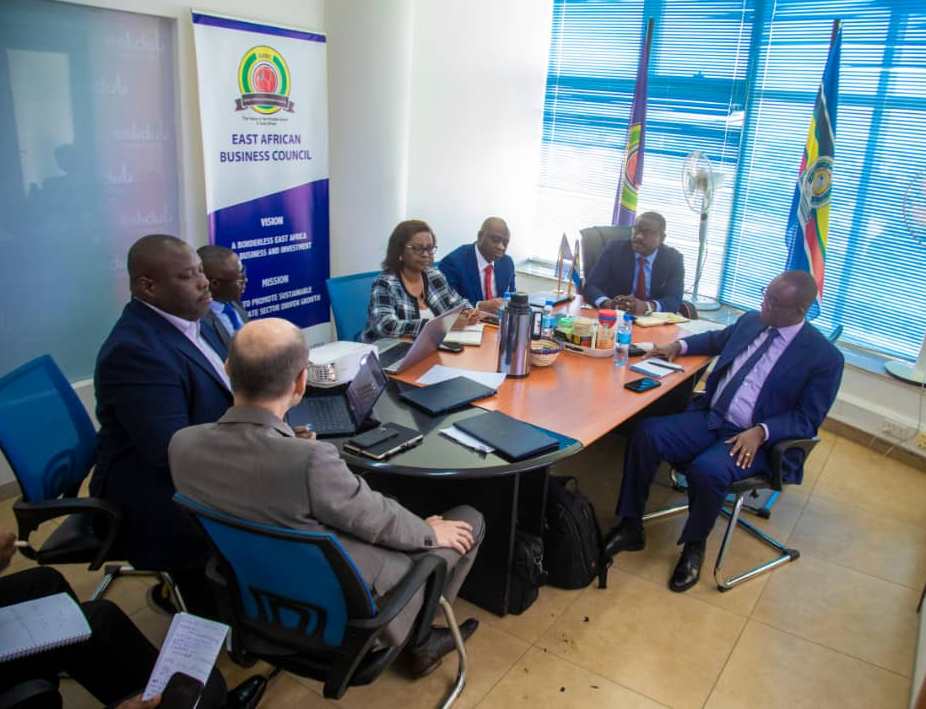 In a meeting with a team at the East African Business Council, the AfDB delegation was told of the importance of local content in infrastructure projects and the holistic involvement of stakeholders to identify investment opportunities.
As of June 2025, the African Development Bank’s (AfDB) multinational operations in East Africa accounted for 36.6% of its commitments in the region comprising of 107 projects worth $6.3 billion.
Since 2023, the portfolio has grown by $1.3 billion, driven by investments in transport, social, multi-sector, and environment. Recently, an AfDB delegation led by Bubacarr Sankareh, the East Africa Lead Operations Advisor, was in the region to assess impact, with discussions involving people both in the public and private sector.
The mission was to review the AfDB East Africa Regional Integration Strategy Paper (EA-RISP 2023-2027) and evaluate the performance of the 2025 regional portfolio.
Sankareh said, “The overarching development challenge for the region remains the slow pace of structural transformation which hampers trade, creation of decent jobs, inclusive growth, and poverty reduction in the region.”
The mission took stock of the progress made in implementing the strategy, and identified opportunities to strengthen collaboration with regional stakeholders and enhance the impact and sustainability of ongoing and future operations.
Delegation members included Eva Ruganzu, East Africa Implementation Support Division Manager; Samuel Kamara, Chief Regional Program Coordinator; Patrick Kanyimbo, Chief Regional Integration Coordinator; Emmanuel Nyirinkwaya, Regional Fragility and Resilience Officer, as well as the Independent Evaluation team.
Sankareh said RISP was developed to address the region’s key development challenges by aligning with the AfDB’s overall strategy, development plans of regional member countries, and the African Union’s Agenda 2063.
The current RISP has enabled major infrastructure projects, including phase one of the Tanzania–Burundi–DRC Standard Gauge Railway, the Burundi–Rwanda Integrated Development Project, and the Comoros Maritime Corridor Development and Trade Facilitation Project, all aimed at boosting transport connectivity, trade, and economic integration across the region.
In addition, the Bank has supported technical assistance and policy dialogues with regional institutions, underscoring its adaptability and commitment to advancing regional priorities.
In a meeting with a team at the East African Business Council, Adrian Njau, the acting EABC CEO said, “These projects have enabled regional integration, reduced cost of doing business and enhanced the competitiveness of products within the region.”
He further appreciated AfDB for partnering with EABC under the project ‘Accelerating Sustainable and Inclusive Industrialization in the EAC’, aimed at deepening integration, growth, and the competitiveness of priority manufacturing value chains in edible oil, leather, and textiles.
Referring to lessons learned from AfDB-funded projects and recommendations for improved portfolio performance, Njau highlighted the importance of local content in infrastructure projects and the holistic involvement of stakeholders to identify investment opportunities along transport corridors such as economic zones and warehouses.
He said the EAC has made significant progress on initiatives such as the East African Bond, East African Payment and Settlement System, and the One Network Area for telecommunications. Efforts are now underway in data harmonization.
The RISP is the Bank’s regional programming instrument, guiding interventions to advance integration at a regional level. AfDB’s regional strategy focuses on two priority areas: improving regional infrastructure—with a focus on energy, transport and ICT connectivity—and developing regional value chains to facilitate trade.
Related Posts
 Equity Bank Uganda set to close 2025 on firmer footing as clean-up phase gives way to growth
 Stanbic targets wider access to affordable financing with ‘Oli In Charge’ campaign
 USA–Canada certification dispute could expose Uganda and regional airlines to regulatory risk
 Sumsub launches AI Agent Verification as Africa grapples with surge in AI-driven fraud
 KPMG flags widening execution gap as tech leaders bet on AI maturity, talent and partnerships
 Uganda targets 200,000 visitors for 2026 National Agricultural Show in Jinja
Get business news delivered to you everyday
Latest News

Equity Bank Uganda set to close 2025 on firmer footing as clean-up phase gives way to growth

Stanbic targets wider access to affordable financing with ‘Oli In Charge’ campaign

USA–Canada certification dispute could expose Uganda and regional airlines to regulatory risk

Sumsub launches AI Agent Verification as Africa grapples with surge in AI-driven fraud

The hidden cost of blocked airline funds

KPMG flags widening execution gap as tech leaders bet on AI maturity, talent and partnerships

Destination Uganda clinches “Best in Show – Africa” at New York Travel & Adventure Show

Uganda’s Kibirige edges closer to global golf stage after strong PGTI Q-School showing in India

Breathtaking Uganda unveils curated Easter getaway to Zanzibar

IATA, CFM renew agreement to ease engine maintenance bottlenecks as supply chain crisis deepens