

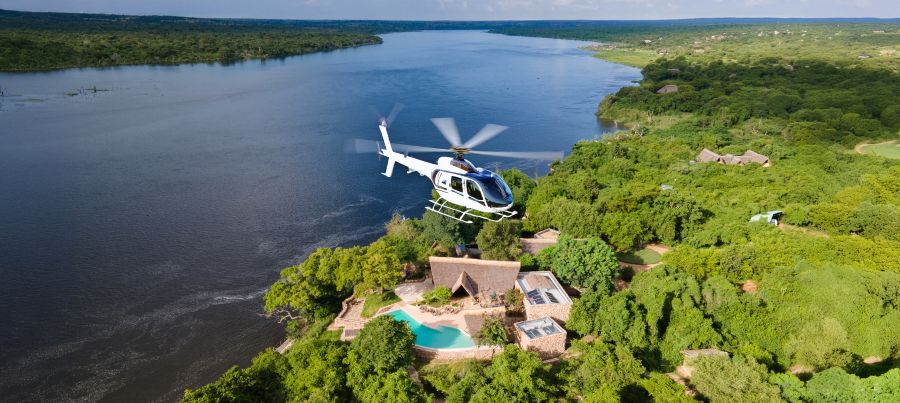
Uganda’s high-end tourism offering has received a significant boost with the launch of ‘Elevate’, the country’s first luxury helicopter safari experience. The new venture, a collaboration between Nile Safari Lodge, Kampala Executive Aviation (KEA), and NOVAM Ltd., aims to reposition Uganda as a premier destination for luxury travel in the region.
‘Elevate’ offers an alternative to traditional road-bound safaris, targeting affluent travelers seeking convenience, exclusivity, and panoramic access to Uganda’s renowned natural assets—including Murchison Falls National Park, the Nile River, Lake Victoria, and Bwindi Impenetrable Forest.
The introduction of helicopter-based safaris aligns with broader trends in African tourism, where high-net-worth travellers increasingly demand personalised and time-efficient ways to explore remote destinations.
“For over 25 years, our family has called Uganda home with a mission to present it as a world-class travel destination. Elevate is an expression of that mission—providing discerning travellers with a new, immersive way to experience the country’s natural beauty,” said Nathalie Van Pée, Director of Nile Safari Lodge.
The experience is powered by Kampala Executive Aviation (KEA), one of Uganda’s leading private aviation firms. KEA, which also serves the oil and gas sector, brings operational expertise and a safety-first reputation to the venture.
“Elevate is not just about offering a helicopter ride. It’s about delivering an unmatched journey—one that reflects the best of Ugandan hospitality, scenery, and aviation excellence,” said Philip Gill, Director of KEA.
Beyond its appeal to luxury tourists, the launch of Elevate is seen as a strategic play within Uganda’s evolving tourism economy, where value-added experiences are key to increasing per capita tourist spending. With visitor numbers recovering post-pandemic, Uganda’s tourism players are now prioritising innovation and diversification to stay competitive in the East African market.
The helicopter safari could also have implications for regional tourism corridors, allowing faster access between otherwise hard-to-reach attractions—something that may appeal not only to tourists but to conservation partners, researchers, and investors scouting new opportunities.
While pricing details were not immediately disclosed, the venture is clearly positioned at the top of the market, joining a growing list of private-sector-led efforts to reposition Uganda beyond the budget safari image and toward a more upscale, experiential model.
In a tourism sector still recovering from the aftershocks of COVID-19, the success of initiatives like Elevate may provide a useful barometer for investor confidence and the country’s broader ambitions to tap into high-value, low-volume tourism.
As Uganda looks to increase its competitiveness within the East African tourism circuit, initiatives like Elevate signal a shift in how the country packages and delivers its natural heritage to the world.
 Government reaffirms commitment to capitalise UDB as Bank deepens development finance role
 Uganda’s DEI Biopharma gene therapy breakthrough could transform sickle cell treatment
 Equity Bank Uganda set to close 2025 on firmer footing as clean-up phase gives way to growth
 Stanbic targets wider access to affordable financing with ‘Oli In Charge’ campaign
 USA–Canada certification dispute could expose Uganda and regional airlines to regulatory risk
 Sumsub launches AI Agent Verification as Africa grapples with surge in AI-driven fraud


