
Nile Breweries, WWF complete restoration of key River Rwizi catchment in Kibaale
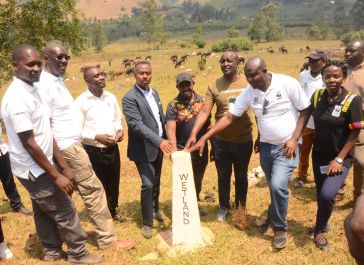 Nile Breweries’ Legal and Corporate Affairs Lead, Emmanuel Njuki (5L), Rwampara County MP Amos Nkankunda (4L), and WWF Country Director Ivan Tumuhimbise (2L), joined by officials from Rwampara, launched the demarcation and restoration of a wetland area along the River Rwizi. The wetland has, for years, suffered from degradation due to unregulated human activities such as sand mining, brick-making, and farming
Working in concert with World Wide Fund for Nature Uganda (WWF), beer maker Nile Breweries Limited (NBL), has completed the demarcation and restoration of 15 kilometres of the Kibaale Wetland in the Kakigani micro-catchment, a key tributary of River Rwizi in southwestern Uganda.
The 84-hectare wetland, stretching roughly 25 kilometers, has long been under pressure from sand mining, brick-making, and unregulated farming. Over the years, this degradation has weakened its ability to protect River Rwizi, which serves as the main water source for millions in Mbarara and surrounding districts.
“We’re already seeing signs of natural regeneration, and encouragingly, communities are beginning to embrace wetland conservation as essential to protecting the ecosystem,” said Emmanuel Njuki, NBL’s Legal and Corporate Affairs Lead. “Wetlands support food production, purify water, and help recharge groundwater systems. Their health directly impacts our lives.”
The restoration aligns with the Rwizi Catchment Management Plan, and builds on years of NBL’s work in soil and water conservation, agroforestry, riverbank rehabilitation, and community livelihood projects.
“River Rwizi is the backbone of life and livelihood for millions of people in Mbarara District,” Njuki noted. “We are proud to support interventions that contribute to improved water quality and quantity in the river’s system.”
As part of the initiative, NBL unveiled 13 new concrete rainwater harvesting tanks — each with a 10,000-litre capacity — serving six villages in Rwampara District. The tanks now bring the total to 22 installed since the project began, benefiting more than 1,000 residents in Rutooma, Kanyangi, Biti, Kitookye, Karagwe, and Kacucu.
“The tanks capture rainwater from rooftops, reducing erosion caused by stormwater runoff,” Njuki explained. “They also ease the burden on school-going children who previously had to walk long distances to fetch water. With closer access to clean water, children can now attend school regularly.”
To ensure the effort delivers lasting results, two water monitoring stations have been set up downstream of the restoration area to track flow and quality in real time. A new box culvert at Ndeija Wetland has also replaced a frequently flooded section of road, restoring year-round community access to schools, markets, and health centres.
“During the rainy season, the wetland would often flood, cutting off communities,” Njuki said. “This new bridge restores access and guides floodwaters safely into the wetland. That’s a win for both people and the environment.”
Since 2019, NBL and WWF have been running a comprehensive programme to address water security in the Rwizi catchment. The target: ensuring that by 2025, all communities in high-stress areas enjoy measurably better water availability and quality.
For Ivan Tumuhimbise, WWF Uganda’s Country Director, the partnership’s work is as much about the future as it is about the present.
“River Rwizi is a lifeline for both people and biodiversity in south-western Uganda,” Tumuhimbise said. “The restoration of Kibaale Wetland is not only reviving the health of this critical river system but also directly improving the livelihoods of surrounding communities. We remain steadfast in our efforts to protect and preserve River Rwizi for present and future generations.”
Related Posts
 Government reaffirms commitment to capitalise UDB as Bank deepens development finance role
 Uganda’s DEI Biopharma gene therapy breakthrough could transform sickle cell treatment
 Equity Bank Uganda set to close 2025 on firmer footing as clean-up phase gives way to growth
 Stanbic targets wider access to affordable financing with ‘Oli In Charge’ campaign
 USA–Canada certification dispute could expose Uganda and regional airlines to regulatory risk
 Sumsub launches AI Agent Verification as Africa grapples with surge in AI-driven fraud
Get business news delivered to you everyday
Latest News

Government reaffirms commitment to capitalise UDB as Bank deepens development finance role

Uganda’s DEI Biopharma gene therapy breakthrough could transform sickle cell treatment

Equity Bank Uganda set to close 2025 on firmer footing as clean-up phase gives way to growth

Stanbic targets wider access to affordable financing with ‘Oli In Charge’ campaign

USA–Canada certification dispute could expose Uganda and regional airlines to regulatory risk

The hidden cost of blocked airline funds

KPMG flags widening execution gap as tech leaders bet on AI maturity, talent and partnerships

Uganda targets 200,000 visitors for 2026 National Agricultural Show in Jinja

Destination Uganda clinches “Best in Show – Africa” at New York Travel & Adventure Show

Uganda’s Kibirige edges closer to global golf stage after strong PGTI Q-School showing in India