

USA–Canada certification dispute could expose Uganda and regional airlines to regulatory risk
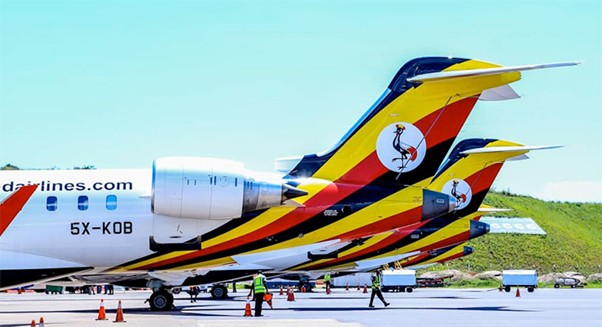
A brewing certification dispute between the United States and Canada could have unintended consequences for African aviation. With Uganda Airlines operating CRJ-900s, RwandAir flying CRJs and Air Tanzania relying on Airbus A220s, industry experts warn that any disruption to FAA recognition of Canadian-built aircraft could expose regional airlines to regulatory uncertainty, higher costs and potential operational disruptions.
A growing certification dispute between the United States and Canada over aircraft approvals could have far-reaching implications for East Africa’s aviation sector, with Uganda Airlines, RwandAir and Air Tanzania among carriers potentially exposed should regulatory tensions escalate into formal action.
The concern follows remarks attributed to US President Donald Trump accusing Canada of unlawfully refusing to certify certain Gulfstream business jets and threatening retaliatory measures against Canadian-built aircraft.
Industry sources suggest the escalation may be linked to Canada’s reluctance to approve Gulfstream’s latest G700 and G800 business jets before the US Federal Aviation Administration (FAA) completes full certification of the aircrafts’ fuel systems. Trump has accused Canada of “wrongfully and illegally” refusing to certify several Gulfstream models, arguing that the delay amounts to a de facto market barrier, and has threatened retaliatory measures against Canadian-built aircraft in response.
Trump has threatened to revoke the US Federal Aviation Administration (FAA) type certification for all Canadian-manufactured aircraft. The move would potentially affect a wide range of platforms, including Bombardier Challenger business jets and commercial aircraft such as the CRJ regional jet family and the Airbus A220, all of which rely on FAA certification as a primary or reference standard in many global markets.
While the comments themselves carry no immediate regulatory force, aviation specialists warn that any disruption to Federal Aviation Administration (FAA) type certificate recognition would reverberate globally, particularly in markets that rely heavily on FAA approvals.
In Uganda’s case, the exposure is direct. Uganda Airlines operates four Bombardier CRJ-900 regional jets, aircraft whose certification lineage traces back to Canadian manufacture and FAA type certification. Industry experts note that the Uganda Civil Aviation Authority (UCAA), like many regulators in Africa, has historically accepted FAA type certificates as the basis for local aircraft registration and airworthiness approval.
“If an FAA type certificate were revoked or suspended, any aircraft registered on the back of that approval would immediately face regulatory uncertainty,” an aviation executive commented in online discussions. “In some cases, that could mean grounding until an alternative certification basis is established.”
Regional fleets at stake
The risk extends beyond Uganda. RwandAir also operates Bombardier CRJ aircraft and Dash 8 turboprops, which play a critical role in its regional network, while Air Tanzania operates Airbus A220s, a programme with deep Canadian industrial roots through Airbus Canada.
Across East and Southern Africa, these aircraft types are essential for thin regional routes, secondary city connectivity and feeder traffic, making them central to airline economics. Any disruption to their certification status could trigger flight suspensions, increased compliance costs and operational delays.
Aviation professionals caution that even without outright grounding, regulatory ambiguity alone can have material consequences, including higher insurance premiums, additional maintenance scrutiny and reduced asset values for leased aircraft.
The situation underscores a broader structural vulnerability in African aviation: dependence on foreign certification authorities, particularly the FAA and the European Union Aviation Safety Agency (EASA). While this reliance reduces regulatory costs and accelerates fleet entry, it also exposes African operators to disputes that originate far outside the continent.
“In Africa, the FAA has long been the default reference point for certification,” said one industry observer. “When that reference point becomes politicised or unstable, the impact is felt immediately by operators who have no alternative certification pathway.”
The dispute also comes amid heightened global scrutiny of aircraft certification practices following the Boeing 737 MAX crisis and renewed debate over FAA exemptions granted to manufacturers, including Gulfstream. These developments have sharpened sensitivities around regulatory credibility and consistency.
At present, there has been no formal move by the FAA to revoke or suspend Canadian aircraft type certificates, and all affected aircraft remain fully airworthy and operational. However, experts stress that aviation regulation operates as much on confidence as on rules, and uncertainty alone can disrupt fleet planning, financing and route development.
For Uganda and its regional peers, the episode is likely to rekindle discussion around diversifying certification recognition frameworks, strengthening local technical capacity and reducing reliance on a single external authority. Additionally, the episode serves as a reminder that global aviation is deeply interconnected—and regulatory or political disputes thousands of kilometres away can quickly cascade onto African flight schedules and balance sheets.
Related Posts
 Equity Bank Uganda set to close 2025 on firmer footing as clean-up phase gives way to growth
 Stanbic targets wider access to affordable financing with ‘Oli In Charge’ campaign
 Sumsub launches AI Agent Verification as Africa grapples with surge in AI-driven fraud
 KPMG flags widening execution gap as tech leaders bet on AI maturity, talent and partnerships
 IATA, CFM renew agreement to ease engine maintenance bottlenecks as supply chain crisis deepens
 Ethiopian Airlines’ new mega-hub reshapes Africa’s aviation stakes
Get business news delivered to you everyday
Latest News

Equity Bank Uganda set to close 2025 on firmer footing as clean-up phase gives way to growth

Stanbic targets wider access to affordable financing with ‘Oli In Charge’ campaign

USA–Canada certification dispute could expose Uganda and regional airlines to regulatory risk

Sumsub launches AI Agent Verification as Africa grapples with surge in AI-driven fraud

The hidden cost of blocked airline funds

KPMG flags widening execution gap as tech leaders bet on AI maturity, talent and partnerships

Uganda targets 200,000 visitors for 2026 National Agricultural Show in Jinja

Destination Uganda clinches “Best in Show – Africa” at New York Travel & Adventure Show

Uganda’s Kibirige edges closer to global golf stage after strong PGTI Q-School showing in India

Breathtaking Uganda unveils curated Easter getaway to Zanzibar