

EgyptAir taps SITA for major tech overhaul
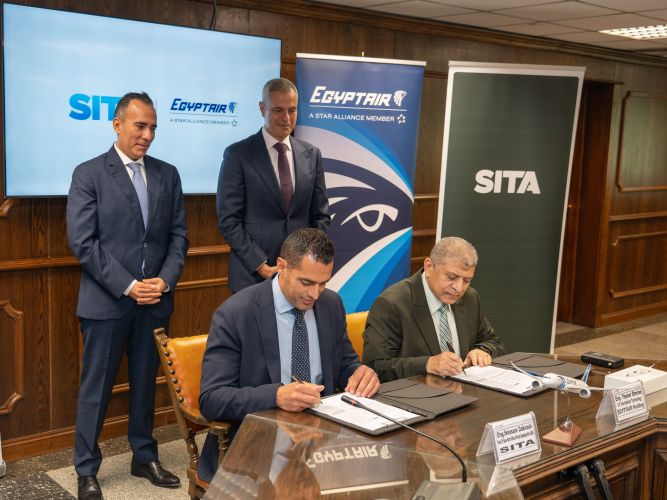 Selim Bouri, President, Middle East & Africa, SITA (back left)
Capt. Ahmed Adel, Chairman & CEO of EGYPTAIR Holding Company (back right)
Houssam Dakroub, Director, North & French speaking Africa at SITA (front left)
Eng. Yasser Omran, Head of the Information Sector at EGYPTAIR Holding Company (front right)
Selim Bouri, President, Middle East & Africa, SITA (back left)
Capt. Ahmed Adel, Chairman & CEO of EGYPTAIR Holding Company (back right)
Houssam Dakroub, Director, North & French speaking Africa at SITA (front left)
Eng. Yasser Omran, Head of the Information Sector at EGYPTAIR Holding Company (front right)
National carrier modernizes infrastructure for a more agile, secure, and passenger-friendly future
Aviation & Technology Desk |
Flag carrier EgyptAir, has signed a strategic agreement with global air transport IT specialist SITA, to support a digital transformation project. The partnership, unveiled in Cairo on May 20, 2025, aims to modernize the airline’s entire network infrastructure to enhance operational efficiency, resilience, and the overall passenger experience.
Under the agreement, EgyptAir will deploy SITA Connect Go, a cloud-based connectivity platform that offers enhanced bandwidth, secure airport connections, infrastructure protection, and advanced messaging and service assurance. The implementation of these solutions is expected to streamline communication, automate core functions, and reduce dependence on legacy technologies. EgyptAir will also adopt SITA’s Community Departure Control System, a solution designed to optimize ground operations and improve cost efficiency across its network.
The agreement was signed by Eng. Yasser Omran, Head of the Information Sector at EgyptAir Holding Company, and Houssam Dakroub, SITA’s Director for North and French-speaking Africa. It was witnessed by Capt. Ahmed Adel, Chairman and CEO of EgyptAir Holding Company, and Selim Bouri, SITA’s President for the Middle East and Africa. The event marked a significant milestone in the airline’s efforts to stay competitive in an increasingly digital and demanding aviation environment.
Speaking at the signing, Capt. Ahmed Adel said the partnership was “a cornerstone of our digital transformation strategy. By adopting cutting-edge solutions, we are enhancing our communication systems to support growth in tourism and travel, ensuring operational excellence and a superior passenger experience.”
SITA’s Selim Bouri underscored the broader regional significance of the agreement. “Airlines across the Middle East and Africa are facing a period of rapid change. Passenger demand is surging, airports are getting busier, and the pressure to operate more efficiently, securely, and sustainably has never been greater. EgyptAir is making a bold move to transform its network infrastructure, giving the airline the speed, resilience, and agility it needs to keep pace with market growth and rising traveler expectations.”
The overhaul comes at a critical time for African and Middle Eastern carriers. As the aviation sector rebounds and scales up, the ability to adapt quickly, handle data securely, and ensure operational continuity is essential. EgyptAir’s initiative places it among a growing group of forward-looking carriers that are investing in digital infrastructure to drive sustainable growth and enhance service delivery.
The improved systems will also enhance performance at Egyptian airports and contribute to national goals for tourism and logistics expansion.
This is not SITA’s first major transformation project in the region, but the partnership with EgyptAir highlights the company’s commitment to supporting aviation players across Africa and the Middle East. It also reinforces SITA’s unique position in the industry as a trusted partner for governments, airports, and airlines navigating complex digital challenges.
SITA, the Geneva-based Société Internationale de Télécommunication Aéronautique, is an independent air transport IT and communications provider. It is distinct from South Africa’s State Information Technology Agency, despite sharing the same acronym. SITA’s clients include over 75 governments, including every G20 nation, reflecting its critical role in modernizing global aviation infrastructure.
Related Posts
 Government reaffirms commitment to capitalise UDB as Bank deepens development finance role
 Uganda’s DEI Biopharma gene therapy breakthrough could transform sickle cell treatment
 Equity Bank Uganda set to close 2025 on firmer footing as clean-up phase gives way to growth
 Stanbic targets wider access to affordable financing with ‘Oli In Charge’ campaign
 USA–Canada certification dispute could expose Uganda and regional airlines to regulatory risk
 Sumsub launches AI Agent Verification as Africa grapples with surge in AI-driven fraud
Get business news delivered to you everyday
Latest News

Government reaffirms commitment to capitalise UDB as Bank deepens development finance role

Uganda’s DEI Biopharma gene therapy breakthrough could transform sickle cell treatment

Equity Bank Uganda set to close 2025 on firmer footing as clean-up phase gives way to growth

Stanbic targets wider access to affordable financing with ‘Oli In Charge’ campaign

USA–Canada certification dispute could expose Uganda and regional airlines to regulatory risk

The hidden cost of blocked airline funds

KPMG flags widening execution gap as tech leaders bet on AI maturity, talent and partnerships

Uganda targets 200,000 visitors for 2026 National Agricultural Show in Jinja

Destination Uganda clinches “Best in Show – Africa” at New York Travel & Adventure Show

Uganda’s Kibirige edges closer to global golf stage after strong PGTI Q-School showing in India