

Civil society flags fiscal, social sector risks in Uganda’s FY2026/27 Budget Framework
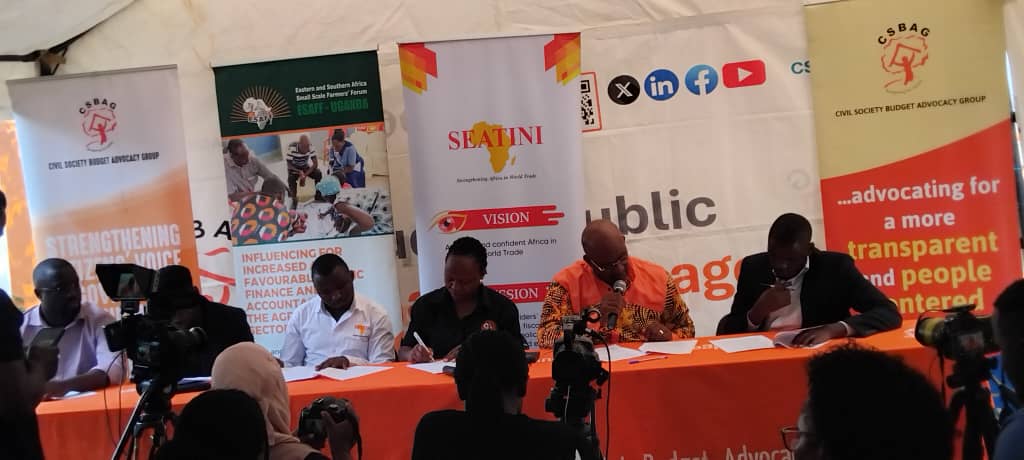
Civil society groups have warned that Uganda’s FY2026/27 Budget Framework could undermine critical services despite stable macroeconomic indicators. CSBAG says shrinking resources, rising debt, and reduced allocations to human development threaten frontline sectors as Parliament reviews the draft budget.
Civil society organisations under the Civil Society Budget Advocacy Group (CSBAG) have warned that Uganda’s draft FY2026/27 National Budget Framework Paper—tabled in Parliament in December—risks widening service-delivery gaps despite maintaining macroeconomic stability.
Addressing journalists in Kampala today, CSBAG Executive Director Julius Mukunda said the government’s commitment to the theme of “Full Monetisation of the Ugandan Economy” remains undercut by declining resources, uneven programme allocations, mounting public debt, and persistent shortfalls in frontline sectors such as health, education and local government service delivery.
CSBAG applauded government for sustaining economic growth—projected at 6.5–7pc this financial year—and for releasing 58pc of the FY2025/26 budget at mid-year, signalling strong fiscal execution. The size of the economy is expected to reach USD 68.4 billion.
However, the resource envelope for fiscal 2026/27 is set to contract by 4.1pc, falling from UGX 72.4 trillion to UGX 69.4 trillion, primarily due to lower external financing, reduced budget support and scaled-back domestic borrowing. Only domestic revenue is projected to grow, rising to UGX 40 trillion on the back of improved tax mobilisation.
Capital-heavy programmes gain as human development budgets shrink
Only eight out of 18 programmes registered increases. The largest jump—94pc—went to Sustainable Extractives Industry Development, followed by gains in natural resources, energy, regional balanced development and transport infrastructure.
By contrast, allocations for Human Capital Development fell sharply by UGX 1.63 trillion, while agro-industrialisation, manufacturing, digital transformation, tourism, and governance programmes recorded reductions. Mukunda said the trend highlights “a persistent bias toward capital-intensive investment at the expense of social development.”
Even within the productivity cluster, ATMS programmes (agriculture, tourism, manufacturing and science/technology) will receive UGX 3.96 trillion—an improvement from FY2025/26 but still UGX 797 billion below National Development Plan IV targets.
Debt pressures deepen as domestic borrowing dominates
Uganda’s public debt rose to USD 32.3 billion by June 2025, driven primarily by infrastructure spending and pre-election pressures. Domestic debt now accounts for the largest share, reaching UGX 63.9 trillion by September 2025.
The consequences are stark. Debt-service costs have climbed to 25pc of government revenue—double the recommended ceiling—tightening liquidity and pushing commercial lending rates to nearly 19pc, among the highest in the region. CSBAG warned that rising interest costs risk squeezing essential services after the February elections.
Health sector staffing crisis and stalled insurance reforms
Civil society highlighted a severe human-resources-for-health gap, with public facilities staffed at just 34pc of approved norms and stark disparities between urban and rural areas. Uganda has only 50–60 psychiatrists nationwide, leaving most districts reliant on overstretched health workers and Village Health Teams.
CSBAG urged government to fund phased recruitment for lower-level facilities and deploy psychiatric specialists to each district hospital. It also renewed calls for the long-delayed National Health Insurance Scheme to be enacted, arguing that heavy out-of-pocket spending—up to 41pc of income—is impoverishing households.
The coalition also cited declining classroom–pupil, latrine–pupil, and desk–pupil ratios, with severe staffing shortages in hard-to-reach regions such as Karamoja and West Nile. Although government is pushing a digital learning agenda, many schools still fail to meet minimum standards.
CSBAG proposed funding for new teachers and rehabilitation of primary school infrastructure alongside investments in digital tools.
While UGX 3.3 trillion has been channelled to parishes under the Parish Development Model, CSOs warned that failure to secure markets for increased agricultural output risks depressing farm-gate prices. They urged government to strengthen PDM’s marketing component to avoid “production without profitability”.
Local governments continue to underperform on revenue mobilisation despite improvements, with collections still equivalent to only 0.1pc of GDP. Land-tenure insecurity also persists, with only 23pc of land registered nation-wide; CSBAG called for expansion of systematic land adjudication and sustainable financing models.
CSOs recommended increased investment in affordable electricity access, clean water, emergency medical care, WASH in schools and health facilities, agricultural extension services, and digitalisation of government systems. They also urged greater support for audit institutions whose budgets have stagnated despite expanded mandates.
CSBAG concluded that while fiscal discipline and macroeconomic stability remain strong, the draft budget still falls short on human development, local service delivery capacity and inclusive productivity. The coalition said it stands ready to engage Parliament as the budget process moves into its next phase, emphasising that “economic growth must translate into improved welfare for all Ugandans.”
Related Posts
 Airbus lifts deliveries to 793 jets in 2025 as backlog hits new record, signalling sustained demand from global carriers
 Uganda coffee earnings hit record UGX 8.8 trillion as export volumes surge
 COMESA issues consumer alert as Nestlé recalls infant formula over safety fears
 Kenchic completes takeover of Uganda’s Yo Kuku after COMESA clears merger
 EBO SACCO leans on Equity Bank to drive financial inclusion
 Africa leads global air travel growth as airlines post double-digit surge
Get business news delivered to you everyday
Latest News

Ethiopian Airlines’ new mega-hub reshapes Africa’s aviation stakes

Civil society flags fiscal, social sector risks in Uganda’s FY2026/27 Budget Framework

Airbus lifts deliveries to 793 jets in 2025 as backlog hits new record, signalling sustained demand from global carriers

Airbus wins contract for 340 New OneWeb satellites as global race for LEO dominance intensifies

Uganda coffee earnings hit record UGX 8.8 trillion as export volumes surge

COMESA issues consumer alert as Nestlé recalls infant formula over safety fears

Kenchic completes takeover of Uganda’s Yo Kuku after COMESA clears merger

EBO SACCO leans on Equity Bank to drive financial inclusion

Africa leads the world in air cargo growth as global freight demand strengthens

Uganda’s private sector ends 2025 on solid ground as demand fundamentals strengthen