

Boeing signs deal to transform Angola’s aviation sector
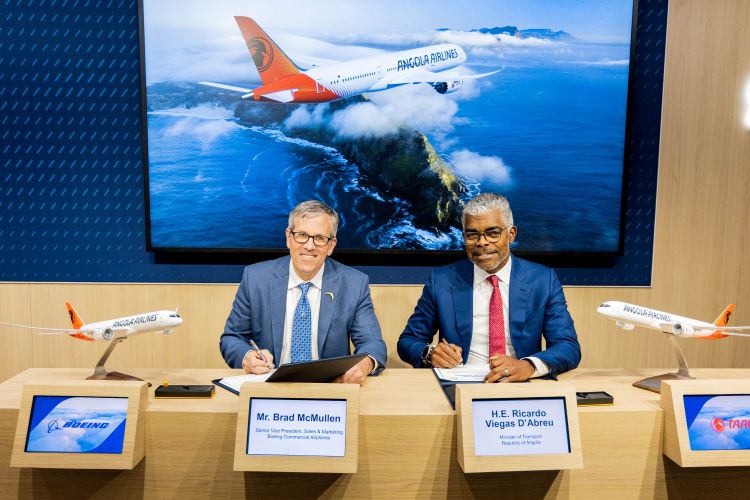
TAAG Angola Airlines to benefit from modernization, efficiency upgrades, and global network expansion
At the 2025 Paris Air Show, the Government of Angola and U.S. aerospace giant Boeing signed a landmark Memorandum of Strategic Cooperation aimed at accelerating the transformation of Angola’s aviation sector. The agreement, signed by Angola’s Ministry of Transport, outlines a wide-ranging agenda to modernise national carrier TAAG Angola Airlines and build a more competitive and integrated aviation industry.
Speaking at the signing ceremony in Le Bourget, Transport Minister Ricardo Viegas D’Abreu described the partnership as a major leap toward building a resilient, modern, and economically strategic air transport sector for Angola. He emphasized that the country views aviation not only as a key economic enabler but also as a catalyst for tourism, investment, and broader regional integration. By entering into this agreement with Boeing, the government intends to enhance TAAG’s technical and operational capacity, expand route networks, and position the airline to meet the evolving demands of global travel markets.
“This partnership with Boeing represents a significant step forward in our commitment to enhancing operational capabilities, improving technical and maintenance capacity, and expanding our reach,” said minister D’Abreu. “By investing in modern technologies and practices, we aim to position TAAG Angola Airlines as a leading airline in Africa, capable of meeting the demands of today’s travelers while contributing to the economic diversification and growth of Angola.”
The strategic cooperation agreement covers several layers of reform, including the adoption of digital tools to improve operational efficiency, the strengthening of aircraft maintenance systems, and support for fleet renewal initiatives. TAAG is expected to benefit directly from Boeing’s experience and innovation in commercial aviation, particularly in optimizing aircraft performance, reducing emissions, and introducing data-driven solutions for route and schedule planning.
TAAG, one of Africa’s oldest airlines, has undergone multiple restructuring attempts in the past decade, but its competitiveness has been hampered by an aging fleet, limited capital, and insufficient route flexibility. The memorandum with Boeing offers a new path forward—anchored in modern technology and strategic planning—backed by one of the world’s most established aerospace manufacturers.
Brad McMullen, Boeing’s Senior Vice President of Commercial Sales and Marketing, affirmed the company’s long-term commitment to Africa. “This partnership underscores Boeing’s commitment to supporting the growth of the aviation sector in Angola and continued expansion of TAAG Angola Airlines’ capabilities,” McMullen said. “We look forward to building on nearly eight decades of supporting commercial aviation in Africa.”
Boeing’s deepening relationship with African carriers is a reflection of shifting global dynamics. As Africa’s middle class grows and intra-continental trade accelerates under frameworks like the African Continental Free Trade Area (AfCFTA), demand for air travel is projected to surge. Boeing estimates that Africa will require more than 1,200 new aircraft over the next 20 years to keep pace with these changes. Today, over 60 African airlines operate Boeing aircraft, which constitute nearly 70 percent of the continent’s commercial fleet.
In Angola, the country is making significant investments in aviation infrastructure, including the completion of a new international airport in Luanda. This, combined with strategic partnerships like the one with Boeing, reflects a national effort to establish Angola as a critical aviation hub linking Southern Africa with the rest of the continent and beyond.
The Paris Air Show, often a bellwether of future industry direction, has in recent years seen an increased African presence—not just in terms of fleet orders, but also in high-level engagements like the Angola-Boeing deal. As Minister D’Abreu underscored, the success of this partnership will ultimately be measured by its impact on Angola’s economy, its global connectivity, and its citizens’ ability to travel, trade, and compete in a changing world.
Related Posts
 Government reaffirms commitment to capitalise UDB as Bank deepens development finance role
 Uganda’s DEI Biopharma gene therapy breakthrough could transform sickle cell treatment
 Equity Bank Uganda set to close 2025 on firmer footing as clean-up phase gives way to growth
 Stanbic targets wider access to affordable financing with ‘Oli In Charge’ campaign
 USA–Canada certification dispute could expose Uganda and regional airlines to regulatory risk
 Sumsub launches AI Agent Verification as Africa grapples with surge in AI-driven fraud
Get business news delivered to you everyday
Latest News

Government reaffirms commitment to capitalise UDB as Bank deepens development finance role

Uganda’s DEI Biopharma gene therapy breakthrough could transform sickle cell treatment

Equity Bank Uganda set to close 2025 on firmer footing as clean-up phase gives way to growth

Stanbic targets wider access to affordable financing with ‘Oli In Charge’ campaign

USA–Canada certification dispute could expose Uganda and regional airlines to regulatory risk

The hidden cost of blocked airline funds

KPMG flags widening execution gap as tech leaders bet on AI maturity, talent and partnerships

Uganda targets 200,000 visitors for 2026 National Agricultural Show in Jinja

Destination Uganda clinches “Best in Show – Africa” at New York Travel & Adventure Show

Uganda’s Kibirige edges closer to global golf stage after strong PGTI Q-School showing in India