

ASARECA bets on crop yield prediction tool to boost Uganda agriculture climate resilience
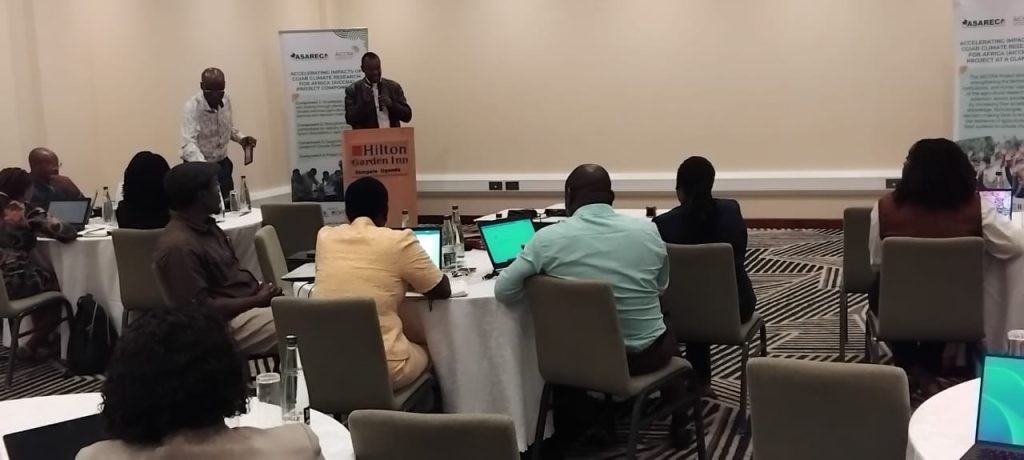
Uganda has taken the first step towards leveraging climate forecast data to predict crop yields, with the introduction of a pioneering crop prediction tool designed to transform how farmers, policymakers, and agribusinesses respond to the country’s increasingly unpredictable weather patterns.
Dubbed the Climate Smart Agriculture Crop Capability Tool, the innovation mines long-term seasonal forecast data, to calculate the probable performance of different crops and varied climate forecast scenarios. The information can then be used to inform planting decisions ranging from variety and quantity to be planted to minimise potential losses while maximising returns under the prevailing conditions.
The same models can be used by policy and decision makers across the public system and private sectors to plan better mitigation measures for disaster scenarios.
From September 22–26, ASAREC – the Association for Strengthening Agricultural Research in Eastern and Central Africa; hosted the first-ever Training of Trainers (ToT) workshop on crop yield prediction modelling tools in East Africa. The training was organised under the Accelerating Impacts of CGIAR Climate Research for Africa (AICCRA) project.
The week-long session brought together crop scientists, climate experts, agricultural researchers, extension workers, and policymakers to learn how to integrate seasonal climate forecasts with crop models for more resilient food systems.
The tool has its roots in southern Africa. After the devastation caused by Cyclone Idai in Malawi, Mozambique, and Zimbabwe in 2023, UNECA and partners commissioned a study to design a simple, climate forecasting yield prediction models that could bridge the gap between climate science and everyday agricultural decisions.
The result was a crop capability prediction model that combines seasonal climate forecasts with established crop models such as DSSAT and a modified version of the Climate Application for Modelling and Decision-making Tool (CAMDT). By running different rainfall and temperature scenarios, the tool produces comparative yield projections for crops such as maize, beans, and sorghum.
“This tool has the potential to save billions of dollars in avoided crop losses across Africa,” said Mr. Bradwell J. Garanganga, lead trainer and senior consultant at Digitron Business Systems. “It allows farmers, governments, and cooperatives to make evidence-based decisions—whether that means switching seed varieties, reducing land under cultivation, or stocking up on animal feed before a drought.”

Bradwell Garanganga
Moving Beyond General Forecasts
For years, one of the biggest hurdles in climate services has been accessibility. Seasonal climate forecasts are often presented in highly technical or vague terms, limiting their usefulness for farmers.
“The advantage of this crop capability prediction tool is that it converts climate forecasts into comparative yield projections for specific crops like beans, maize, or sorghum,” explained Julian Barungi, Programme Officer at ASARECA. “It gives policymakers, extension workers, and farmers clear information about what to plant, where, and when under a given season’s conditions.”
Dr. John Recha, a scientist with the International Livestock Research Institute (ILRI), noted that the training represents a long-term investment in local resilience: “This is about empowering our experts with tools and innovations to improve productivity, adapt to climate change, and ultimately safeguard food security.”
Building Local Capacity
Participants in the Kampala training were drawn from the Ministry of Agriculture, the Uganda National Meteorological Authority, and the National Agricultural Research Organisation. They were trained not only to use the tool to create area-specific models but to tailor it using Ugandan datasets—such as soil types, seed varieties, and crop calendars—so the results reflect the realities of local farming.
The training is designed to be cascaded, meaning trained experts will mentor colleagues in their respective institutions. This approach aims to establish a pool of Ugandan specialists capable of generating regular, evidence-based advisories for farmers and decision-makers.
“This is a process, not a one-off event,” Garanganga stressed. “The models must be adapted to Uganda’s specific conditions, and users of climate data—from farmers to politicians—need to be involved in shaping the products.”
Beyond Crops: Wider Applications
While the primary focus is crop production, the tool has wider applications in agriculture and natural resource management. For example, livestock producers can use seasonal forecasts to plan herd sizes or secure feed before drought strikes, avoiding catastrophic losses that often wipe out livelihoods. Water resource planners can model irrigation needs, while disaster management agencies can prepare for potential food shortages in advance.
“By integrating these forecasts into national systems, Uganda can not only improve food production but also strengthen its disaster preparedness and

Julian Barungi
resilience,” Barungi observed.
Why It Matters for Uganda
Agriculture is the backbone of Uganda’s economy, employing more than 70pc of the population and contributing over a quarter of GDP. Yet the sector is highly vulnerable to climate variability because it is dominated by rain-fed systems. Erratic rainfall and prolonged droughts frequently result in massive losses for smallholder farmers, costing the economy millions of dollars every year.
The introduction of a crop yield prediction tool represents a shift from reactive to proactive agricultural planning. Instead of waiting for poor harvests, Uganda can forecast potential outcomes months in advance and adjust policies, subsidies, and extension messages accordingly.
“This tool helps us move from generalised forecasts to actionable intelligence,” Barungi said. “The primary beneficiary is the farmer, but the ripple effects are national—greater food security, reduced losses, and stronger resilience.”
Expected Outcomes
According to ASARECA, the Kampala training had several immediate objectives. The first was strengthening national capacity in seasonal climate forecast-driven crop yield modelling. The second was enhancing collaboration between meteorological services, agricultural institutions, and policymakers. The third was providing hands-on experience with the modified CAMDT and DSSAT platforms. Finally, participants received a user guide to support institutional adoption of the tool.
The expected outcome is skill transfer that enables Ugandan experts to integrate crop prediction into agriculture and food security planning at both institutional and community levels.
Sponsors and Partners
The initiative is made possible through a network of regional and international sponsors. UNECA’s Africa Climate Policy Centre (ACPC) has played a central role in designing the framework, while the AICCRA project, funded through CGIAR, has provided the platform to scale it across Africa. ASARECA has taken on regional coordination in Eastern and Central Africa, while Digitron Business Systems has supplied technical expertise.
“This collaboration shows what is possible when science, policy, and practice come together,” said Garanganga. “It’s about ensuring that climate information is not just produced but used where it matters most—in the hands of farmers and decision-makers.”
Looking Ahead
The next step is for Ugandan experts to customise the tool for the country’s diverse agro-ecological zones, ranging from the highlands of Kapchorwa to the semi-arid cattle corridors of Karamoja. The aim is to integrate the outputs into national agricultural planning, early warning systems, and extension services.
In time, Uganda could even serve as a hub for spreading the technology across East Africa, building on lessons from southern Africa.
For now, though, the Kampala training marks a turning point: the moment Uganda began to move from broad climate forecasts to precise, actionable crop predictions. As the climate grows more erratic, that shift could prove decisive in securing the nation’s food future.
Related Posts
 Equity Bank Uganda set to close 2025 on firmer footing as clean-up phase gives way to growth
 USA–Canada certification dispute could expose Uganda and regional airlines to regulatory risk
 KPMG flags widening execution gap as tech leaders bet on AI maturity, talent and partnerships
 Destination Uganda clinches “Best in Show – Africa” at New York Travel & Adventure Show
 Uganda’s Kibirige edges closer to global golf stage after strong PGTI Q-School showing in India
 Breathtaking Uganda unveils curated Easter getaway to Zanzibar
Get business news delivered to you everyday
Latest News

Equity Bank Uganda set to close 2025 on firmer footing as clean-up phase gives way to growth

Stanbic targets wider access to affordable financing with ‘Oli In Charge’ campaign

USA–Canada certification dispute could expose Uganda and regional airlines to regulatory risk

Sumsub launches AI Agent Verification as Africa grapples with surge in AI-driven fraud

The hidden cost of blocked airline funds

KPMG flags widening execution gap as tech leaders bet on AI maturity, talent and partnerships

Uganda targets 200,000 visitors for 2026 National Agricultural Show in Jinja

Destination Uganda clinches “Best in Show – Africa” at New York Travel & Adventure Show

Uganda’s Kibirige edges closer to global golf stage after strong PGTI Q-School showing in India

IATA, CFM renew agreement to ease engine maintenance bottlenecks as supply chain crisis deepens