

Africa most fraud-exposed region globally — Uganda ranks near bottom
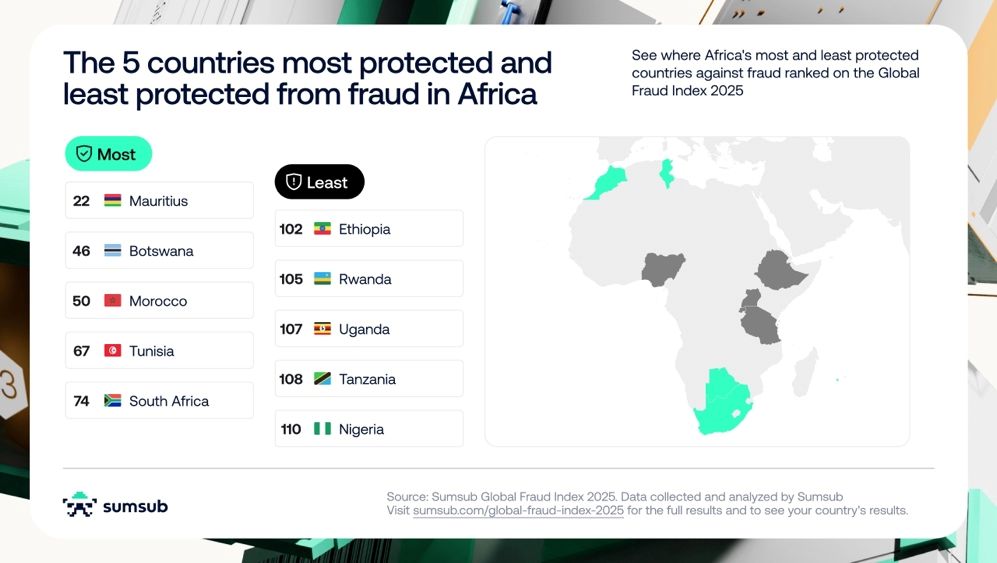
Africa has emerged as the world’s most fraud-exposed region, according to the 2025 Global Fraud Index released by Sumsub in partnership with Statista. The continent recorded an average regional fraud score of 3.84, far above the global average of 2.79, underscoring the scale of exposure facing businesses, financial institutions, and consumers across the region.
The second edition of the annual Index examined fraud exposure across 112 countries, up from 103 last year, evaluating national responses under four pillars: policy frameworks, fraud activity rates, resource accessibility, and economic resilience. Africa ranked lowest globally, followed by Asia Pacific (3.50), the Americas (2.83), and the Middle East (2.25), while Europe (2.13) remained the most protected.
Within Africa, Mauritius stood out as the best-performing country, ranking 22nd globally, ahead of Botswana (46), Morocco (50), Tunisia (67) and South Africa (74). At the other end of the scale, Nigeria (110), Tanzania (108), Uganda (107), Rwanda (105), and Ethiopia (102) were among the world’s least protected nations—reflecting institutional weaknesses, limited anti-fraud resources, and high exposure to digital and financial crime.
Despite its challenges, South Africa recorded the strongest improvement in Africa, rising nine positions from 83rd to 72nd, a movement attributed to strengthened policy interventions and higher awareness of cyber threats.
For the first time, the Index assessed Senegal, Kenya, Uganda, Tanzania, and Nigeria, broadening its African coverage. Senegal ranked lowest in resource accessibility, pointing to significant human and technical capacity constraints in combating emerging forms of fraud.
“Fraud is evolving faster than many national systems can respond,” said Hannes Bezuidenhout, Sumsub’s VP for Africa. “Africa’s digital acceleration presents immense opportunity—but also exposes structural weaknesses that must be addressed through policy harmonisation and technology-driven defences.”
In Uganda, the findings have stirred calls for stronger collaboration among regulators and fintech players. George Wilson Ssenkande, Membership and Programs Lead at the Financial Technology Service Providers Association of Uganda (FITSPA), said Uganda’s inclusion in the Index offers “a benchmark to understand where we stand and where we must improve.” He added that the report “is a wake-up call for greater cooperation between fintechs, regulators, and government institutions to build a more resilient and transparent digital economy.”
Globally, Luxembourg, Denmark, Finland, Norway, and the Netherlands ranked as the most fraud-protected countries, while Pakistan (112), Indonesia (111), and Nigeria (110) anchored the bottom. The report also highlighted notable shifts: Singapore—last year’s leader—fell to 10th, while Morocco and Thailand climbed sharply following targeted reforms.
According to Timothy Owens, Senior Research Lead at Statista, “Fraud protection isn’t about geography—it’s about governance. With AI-powered fraud tools spreading fast, verification systems and incident response mechanisms are no longer optional—they are essential to survival in the digital age.”
The report concludes that Africa’s low scores reflect not failure, but an urgent need for investment in digital infrastructure, coordinated regulation, and capacity building. Addressing these gaps, it says, will determine whether Africa’s digital transformation can proceed securely—and inclusively.
Related Posts
 Equity Bank Uganda set to close 2025 on firmer footing as clean-up phase gives way to growth
 USA–Canada certification dispute could expose Uganda and regional airlines to regulatory risk
 KPMG flags widening execution gap as tech leaders bet on AI maturity, talent and partnerships
 Destination Uganda clinches “Best in Show – Africa” at New York Travel & Adventure Show
 Uganda’s Kibirige edges closer to global golf stage after strong PGTI Q-School showing in India
 Breathtaking Uganda unveils curated Easter getaway to Zanzibar
Get business news delivered to you everyday
Latest News

Equity Bank Uganda set to close 2025 on firmer footing as clean-up phase gives way to growth

Stanbic targets wider access to affordable financing with ‘Oli In Charge’ campaign

USA–Canada certification dispute could expose Uganda and regional airlines to regulatory risk

Sumsub launches AI Agent Verification as Africa grapples with surge in AI-driven fraud

The hidden cost of blocked airline funds

KPMG flags widening execution gap as tech leaders bet on AI maturity, talent and partnerships

Uganda targets 200,000 visitors for 2026 National Agricultural Show in Jinja

Destination Uganda clinches “Best in Show – Africa” at New York Travel & Adventure Show

Uganda’s Kibirige edges closer to global golf stage after strong PGTI Q-School showing in India

IATA, CFM renew agreement to ease engine maintenance bottlenecks as supply chain crisis deepens